That is truly the lamest keyboard cover I’ve ever seen. Just learn the keys. Every time you have to go to the menu or right click to do a function, make it a point to learn the hot key instead. I never understood the use of these. Personally I have no use for the stock keyboard hotkeys. My keyboard is completely custom. The Tilde key is the only thing left of the original setup. Since I have to jump back and forth to Avid I have a some similar setup so that my instinct muscle memory doesnt do anything destructive, therefore V,B are always my insert/overwright. Back when I made the switch from Media100 to Avid I used to do the same thing. I carried around my settings on a … floppy disk!
Since Media100 was very much cmd+ key driven I mapped nearly all the commands I could to avid as shift+ keys, since Avid didn’t map any keys to the shift command for the most part. But a similar problem arose when I forgot to bring my settings with me to a new gig. I was completely useless without my personal settings. I guess the moral is learn the keys, whether they be custom or not.
For Final Cut Pro users, the core idea remains: efficient keyboard shortcuts reduce friction, keep the editing flow uninterrupted, and help you avoid destructive changes caused by accidental keystrokes. A well-planned keymap aligns with your typical editing tasks-from basic playback control to precision trimming and timeline management. In this context, keyboard customization becomes a strategic tool rather than a gimmick.
Why shortcuts matter in Final Cut Pro
Shortcuts streamline common actions like play, pause, scrub, cut, slice, and ripple edits, letting editors maintain momentum. The right hotkeys minimize hand movement and cognitive load, enabling focused decisions rather than hunting through menus. For professionals who juggle multiple projects, consistent shortcuts across sessions save minutes per hour and reduce fatigue during long sessions.
Building a practical key layout
Start by cataloging the functions you perform most often and map them to memorable keys or key combinations. Consider co-locating related actions (e.g., trimming controls) to build muscle memory. If you frequently switch between Final Cut Pro and other software like Avid, choose a hybrid approach that preserves non-destructive workflows while avoiding accidental overrides.
Customizing with caution
Customization is a productivity amplifier, but overly complex mappings can backfire when you’re multitasking on set or switching machines. Keep a lean setup that you can reproduce on different systems. Document or export your configuration so you can recover quickly after a hard drive change or software reinstall.
Practical tips for Final Cut keyboard optimization
- Identify the top 10 actions you perform daily and assign intuitive shortcuts.
- Use modifier keys (Shift, Control, Option) to expand the repertoire without crowding the basics.
- Leverage the built-in command editor to customize and test mappings before committing.
- Group related commands together to leverage motor memory and reduce cognitive load.
- Maintain a lightweight, portable profile that can be loaded on any workstation.
Balancing speed with accuracy
Speed is valuable, but accuracy matters more when you need precise edits. A thoughtful key layout minimizes mistakes by reducing the need to switch context. When you can perform a task with a single keystroke or a simple combination, you reduce the chance of accidental edits that can derail a timeline.
From a veteran perspective: lessons learned
The recurring lesson from editors who rely on keyboard-centric workflows is to learn the keys-whether you use stock defaults or a heavily customized setup. The moral is to learn the keys, whether they be custom or not. By prioritizing consistent mappings and portability, you protect your workflow against memory gaps and equipment changes.
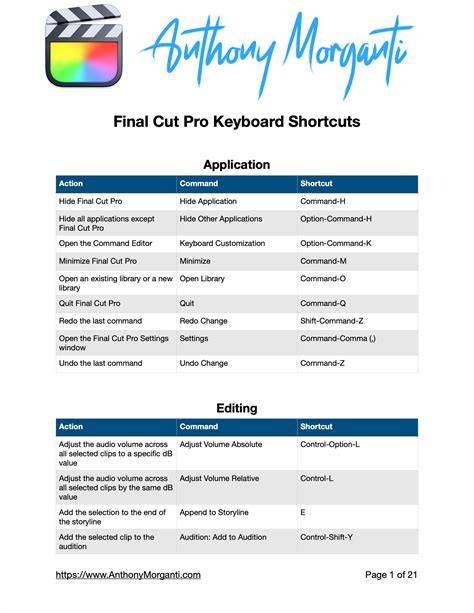
15 Keyboard Shortcuts GUARANTEED To Save You Time! (Final Cut Pro X)
In practice, a balanced approach combines essential stock shortcuts with a personalized layer that aligns with your editing habits. This ensures you're efficient on any project, using muscle memory to keep you in the edit rather than in the menu.
| Task | Popular Shortcut (Default) | Proposed Custom Shortcut |
|---|---|---|
| Play/Pause | Space | Space |
| Blade/Cut | B | Cmd+B |
| Trim | T | Ctrl+T |
| Ripple Delete | Shift+Delete | Shift+Cmd+Backspace |