The Creation of Adam is one of the most recognized frescos found inside the Vatican’s Sistine Chapel. Painted by Michelangelo in 1511-1512 as a commission from Pope Sixtus IV, The Creation of Adam depicts a languid, yet almost tense Adam reaching lazily out to God. God is approaching Adam with his right arm outstretched, supported and surrounded by angels as well as a mysterious female figure. The main focus of the artwork is the minute distance between Adam's and God’s hands, which are on the verge of touching, but are frozen on the precipice.
Adam, at first glance seems lethargic, lying down and lazily holding his arm up to meet God’s. This misconception quickly deteriorates after further inspection. Michelangelo painted Adam’s body tensed, as shown by his bulging left leg and taut arm. It seems that Adam is ready to spring up at any moment, a man ready to accept the gift being offered to him. God, surrounded by flowing hair and an accompaniment of angels, is ready to impart his gift, whatever it may be. God is also protectively embracing a female figure, with his finger on a child, who could potentially be understood as Jesus (Steinberg 559). The female figure has been interpreted to be either Eve, Mary, or Sophia, the human embodiment of the soul (Steinberg 559-560).
Michelangelo utilized a bright palate of colors to depict the scene, with an adept use of shadow to create a sense of depth, especially around God. Michelangelo established a vanishing point to bring depth to the statically charged, but simple background. One of the most interesting contributions of The Creation of Adam is that God is depicted for the first time in a horizontal position. Why Michelangelo chose this representation is unknown, but perhaps plays into what Frank Lynn Meshberger discovered in 1990. Meshberger overlaid a human brain onto the red ribbon-like area where God is placed and found something astonishing. Meshberger found that the shape of God and His entourage matches almost perfectly to the lobes of the brain, the brainstem and pituitary gland, as well as other parts of the brain, such as the optic chiasm (Meshberger 1).
The outstretched foot next to the green ribbon has two parts, similar to the visible difference in the anterior and posterior lobes in the pituitary gland. The dappling light around God and on the angels is no longer simply depth but the grooves and contours of the brain. Michelangelo’s near perfect depiction of the human brain evidences the vast spread of information originating from liberal arts schools in the 15th and 16th centuries. It may feel surprising that an artist, granted one who focused on the human body, had such a deep understanding of the human brain’s anatomy. Michaelangelo’s knowledge, however, supports the idea that the knowledge gained from autopsy at academic institutions like Padua in Italy was not withheld from the population--rather that it was shared (Shotwell 8).
Sponsored by the Medici family, Michelangelo attended a humanist academy in Florence, an early incarnation of contemporary liberal arts colleges. A humanist academy provided opportunities to view cadaver dissections, and Michelangelo dissected cadavers himself, starting when he was only eighteen (Straus 1). Besides this experience, the close likeness of God’s retinue to the brain reveals the vast spread of knowledge coming from places like Padua in Italy, which taught cadaver dissections and trained future doctors. The curriculum involved detailed dissection, where students would watch a professor conduct an autopsy (Bull 10-12). Besides the anatomical knowledge from dissection, students would learn about all disciplines, because doctors oftentimes became professors and were thus required to have at least basic knowledge of multiple areas (Bull 10-20). Padua, as well as other places that trained medical professionals at the time, were the first liberal arts schools.
Michelangelo utilized his knowledge of human anatomy, sculpture, and color to make The Creation of Adam an incredibly complex painting, containing underlying themes about life, specifically man's relationship to God and knowledge. The dissemination of anatomical information from liberal arts schools in the 16th and 17th centuries allowed Michelangelo to allude to the brain in The Creation of Adam. The final parts of the scene link to broader Renaissance currents: the brain as a symbol of knowledge and the human potential to bridge the divine and the mortal through anatomical study.
In the broader context of the Sistine Chapel ceiling, The Creation of Adam sits within a program of nine Genesis episodes centered on creation, humanity, and sin. God’s outstretched arm and Adam’s poised body resonate with theological and philosophical questions that preoccupied Renaissance thinkers-how life is bestowed, how knowledge is acquired, and how humanity stands in relation to the divine.
Scholarly discussions have extended beyond theology into art history, human anatomy, and even neuroaesthetics. The painting’s interplay of life, breath, and the moment just before touch invites viewers to contemplate potential scientific and spiritual accounts of human origin and destiny. In this sense, Michelangelo’s vision fuses artistic mastery with an intellectual curiosity that defined the era’s liberal arts culture and its fascination with the human form.
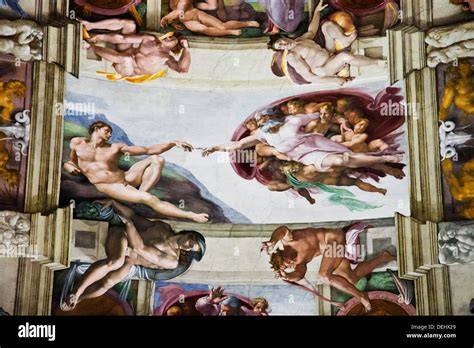
To illustrate how the scene interlaces art and biology, the detailed anatomy of Adam and the brain-like forms around God are often discussed in scholarly circles, underscoring the Renaissance conviction that art and science inform each other.
The Secret Michelangelo Hid in ‘The Creation of Adam’ Will Blow Your Mind
Overall, The Creation of Adam remains a milestone not only for its aesthetic power but also for its hints about Renaissance knowledge networks, medical education, and the ways artists integrated contemporary science into religious narratives.
| Aspect | Description |
|---|---|
| Date | 1511-1512 |
| Location | Sistine Chapel ceiling, Vatican |
| Central Focus | Distance between God’s and Adam’s hands |
| Contemporary Interpretation | Possible brain anatomy references; multi-figure entourage |