Though the first actual helicopter wasn’t built until the 1940s, it is believed that Leonardo da Vinci’s sketches from the late fifteenth century were the predecessor to the modern day flying machine. As with many of da Vinci’s ideas, he never actually built and tested it - but his notes and drawings mapped out exactly how the device would operate. Da Vinci scrawled next to his sketches of the screw-like machine the following description: "If this instrument made with a screw be well made - that is to say, made of linen of which the pores are stopped up with starch and be turned swiftly, the said screw will make its spiral in the air and it will rise high." Also known as the "Helical Air Screw" or simply the "airscrew", the device was designed to compress air to obtain flight - similar to today’s helicopters. Da Vinci was a big proponent of the many possibilities offered by the screw shape, and he used the shape for other inventions and designs as well.
Design and materials
Da Vinci’s helicopter measured more than 15 feet in diameter and was made from reed, linen and wire. It was to be powered by four men standing on a central platform turning cranks to rotate the shaft. With enough rotation, da Vinci believed the invention would lift off the ground. Unfortunately, due to weight constrictions, modern scientists do not believe da Vinci’s invention would have been able to take flight.
Leonardo drew detailed sketches around 1481 for a water lifting device, using an Archimedes screw. Perhaps noting the effect of the screw in moving fluids, and knowing that air itself behaved as a light fluid, in 1489 he presented what we may recognise today as a machine designed to perform like a helicopter. Using the principle of an Archimedes screw in a vertical orientation, he developed the “aerial screw”. This was a rotor in the shape of a helix, approximately four metres in diameter. He proposed that the screw should be made with a frame of reeds supporting a starch-sealed linen covering, supported with wires.
Function and limitations
Leonardo recorded a lot of his work in notes, put together into folios. The drawings in the folio for the aerial screw (known as Manuscript B, folio 83v) appear to show four levers, to be pushed to create rotation of the screw around a vertical axis. These levers suggest that four people would be needed to produce the power required - but it’s impossible for four people to produce anywhere near enough power for flight in this manner. It also neglected the problem of torque reaction - where once in flight the torque created by the people would act to rotate their platform as well as the screw itself.
As with other engineers at that time, Leonardo also studied the flight of birds. In 1505 he published his Codex on the Flight of Birds, noting the shape of a bird’s wing in flight and connecting the idea of air pressure to flight and weight distribution. He considered air as a fluid resisting flight and presented the idea that birds fly by beating their wings and “condensing” the air under the wings. Using this concept of beating wings to pressurise air, he developed a design for an “ornithopter” - a flying machine that achieves flight by flapping it’s wings. As with the aerial screw it would need to be human powered, and sadly we simply don’t have enough muscle power to be able to fly like a bird with our arms.
Historical context and influence
Where’s Icarus when you need him? Human-controlled flight itself would have to wait another 348 years, thanks to the work of Sir George Cayley. He also studied the flight of birds, conducted research to correctly determine aerodynamic forces and therefore remove the link between thrust and flapping wings, designing what we would recognise today as an aircraft. A modern aerodynamics engineer approaching a similar problem to Leonardo’s aerial screw would have an impressive range of techniques, tools and theory at their disposal. The cumulative knowledge of aerodynamics research across the past few centuries - and the supporting mathematical techniques - of course give us far more information than that available to Leonardo. Computational Fluid Dynamics software allows us to understand and investigate fluid flow and forces, while Finite Element Analysis methods allow us to optimise structures for minimum weight.
But our modern engineer and Leonardo do have a lot in common in the engineering process. Both have complex problems to solve. There are unknown values, which must be determined through either physical experiment or mathematical modelling. The final design must be described in a technical drawing, to make it simple to understand and manufacture. It must also, if a commercial product, have an aesthetic appeal. This presents a real challenge to a modern specialist engineer, who may not necessarily have the same superb artistic talents that Leonardo had. It is here that art and science mix, to create an artefact that must perform, but look attractive to customers.
Interpretation and modern view
To imagine ourselves into the time of Leonardo da Vinci, we must first imagine a world without helicopters, parachutes, tanks, diving suits and robots. Yet those all existed for Leonardo himself - or rather, they exist(ed) in his imagination. He didn’t build in real life, he documented in his notebooks, leaving behind material for appreciations of his genius that would continue half a millennial later. In the fourteenth-nineties, however, man power was what people knew, so they instinctively looked for the man. According to the plans in one of Leonardo’s notebooks, his “aerial screw,” involving a linen sail wrapped around a wooden mast, would need four men running in circles around a revolving platform, which would theoretically cause the mast to rotate and the whole contraption to lift into the air.
As designed, it wouldn’t have been able to take off, but in 2019, University of Maryland scientists modified it to work successfully in miniature, as a kind of drone. The aerial screw remains a design idea, not a working helicopter, and it is important to keep that distinction clear when discussing Leonardo’s work. The source material emphasizes that the aerial screw is tied to Manuscript B f. 83v, dated 1486-1487, in Paris at the Institut de France. These models help viewers understand a manuscript idea, but they are not Leonardo-made machines.
The aerial screw matters because it shows Leonardo treating air as a medium that could be acted upon, not because it secretly solved helicopter flight. It sits at the edge between mechanics and imagination, revealing a Renaissance approach to rotating surfaces and aerodynamic analogy. The modern helicopter relies on rotor blades, powered lift and control systems that Leonardo did not possess. The phrase “helicopter” remains a bridge for readers to a rotating-wing design idea rather than a record of a flight achieved by Leonardo.
Key references and interpretation notes
Leonardo’s aerial screw is often labeled as Helicopter in popular culture, but scholars emphasize the distinction between a rotating-wing designed to rise by screw motion and a true modern rotorcraft. The Museo Nazionale Scienza e Tecnologia Leonardo da Vinci provides the core record for the Aerial screw, linking it to Manuscript B f. The page and folio anchors (Manuscript B, f. 83v) help keep the evidence precise and prevent overstatement about flight capabilities. Museums have produced 1953 models and related reconstructions that illustrate the idea without claiming a completed machine.
современная визуализация и примеры
The aerial screw remains a powerful symbol of early experimentation at the boundary of art and science, illustrating how Leonardo combined drawing, mathematics and physical intuition to explore flight. Modern reconstructions and animations help convey the concept to diverse audiences while preserving scholarly cautions about feasibility.
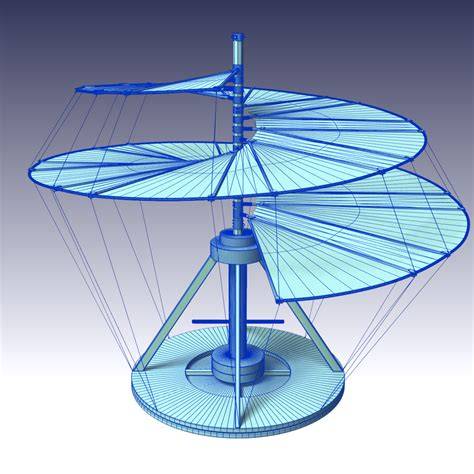
‘Crimson Spin’ brings da Vinci helicopter design to life
tags: #davinci #helicopter #drawing