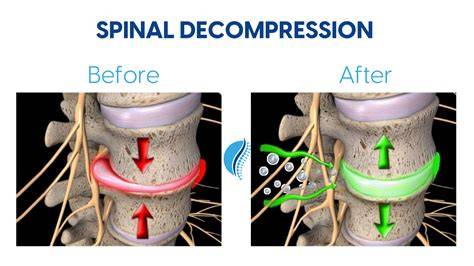
Spinal decompression therapy involves stretching your spine using a manual or motorized traction table to help ease neck, back, or leg pain. It is a non-surgical technique to relieve pressure on your spinal discs and spinal nerves. Spinal decompression treatment may last for 30 to 50 minutes. If spinal decompression therapy and other non-surgical treatments do not provide substantial relief, your doctor may recommend surgery for spinal decompression.
Spinal decompression therapy involves stretching your spine using a manual or motorized traction table to relieve chronic neck, back, or leg pain. It helps take the pressure off your spinal discs and spinal nerves. Decompression therapy is a treatment that helps reduce pain by opening up the space where the affected nerve passes through. This takes pressure off of the nerve and allows healing to occur. This treatment may help if other treatments like rest, physical therapy, or acupuncture haven’t helped.
What Decompression Therapy Aims to Do
If you’re having pain in your spine, hips, knees, or joints, decompression therapy could be an option to help you feel better. This therapy may help reduce pain without needing surgery. Read on to learn more about how decompression therapy works, when you might consider it, and whether it’s a safe choice to treat compressed nerves.
Decompression therapy opens up spaces in areas such as your spine where spinal nerve roots pass through, reducing pressure on them. This may also help reposition joints and treat slipped discs, helping reduce severe or disruptive pain.
Spinal traction can be used to provide spinal compression therapy. This involves manually opening up the spaces where spinal nerve roots pass through. Physical therapists or physicians typically perform this type of traction. These devices perform a more advanced form of mechanical traction via a sensitive computerized feedback mechanism to decompress the spinal nerve roots through a process called segmental distraction.
Decompression therapy is not typically a first-line treatment for nerve pain caused by compression. For mild or temporary compressed nerve pain, a doctor may recommend: resting the affected area, taking over-the-counter (OTC) pain medications, gently stretching with the help of a physical therapist, wearing a brace to prevent further pain or injury.
If these treatments don’t work, a doctor may recommend decompression therapy. You may also need decompression therapy if you have health conditions that result in nerve compression. Examples include: frequent bulging or slipped discs from joint degenerative disc diseases, spinal cord injuries or diseases, radiculopathy, sciatica, spinal stenosis.
When Tests Inform Decompression Therapy
Some tests that help determine the severity of nerve problems and whether decompression therapy will help include: bone scan, CT, EMG, X-rays, MRI. These tests assess fractures, masses, inflammation, disc health, and nerve function to guide treatment decisions.
According to a 2025 report, nonsurgical spinal decompression is generally safe with minimal side effects. However, the report also notes that further research is necessary to determine long-term safety in treating cervical disc herniation. There are very few reported risks associated with decompression therapy. Some reported side effects can include: increase in pain, muscle spasms, fatigue. Some limited research also suggests that decompression therapy may be effective in reducing the symptoms associated with compression, but evidence is mixed.
A 2007 review of studies published between 1990 and 2006 suggests that there’s limited evidence that routine decompression therapy is more effective than less costly alternatives with more research supporting them like exercise or spinal manipulation. An older set of clinical guidelines published in 2012 looked comprehensively at various treatments for lumbar disc herniation with radiculopathy, including decompression therapy. Many treatments didn’t have enough evidence to support their effectiveness, but nonsurgical decompression showed some promise in relieving pain and disability associated with compression. A 2022 study looked at a small sample size of 60 people with herniated discs in their lower back. The researchers separated people into two groups - 30 who received decompression therapy and 30 who didn’t. Results showed that decompression therapy helped noticeably improve symptoms in the group who received it, while the other group didn’t experience any improvement.
What to Expect During Decompression Sessions
A typical decompression therapy session is straightforward: you will be comfortably strapped into a harness system. A computer-controlled table applies precise traction to gently separate vertebrae. The process involves cycles of stretching and relaxation. Sessions last 30 minutes on average. Some patients feel immediate relief, while others improve gradually over several sessions. It is common to need 12 to 20 sessions for significant improvement.
Safety and side effects are generally mild. Reported side effects include soreness or stiffness after sessions, muscle spasms, and temporary tingling in the legs. Serious complications are rare, making decompression therapy a safe alternative for many patients.
Who Is a Good Candidate
You may be a candidate for decompression therapy if you have persistent back, neck, or leg pain from disc herniation, stenosis or sciatica, if you have not responded well to conservative treatments such as rest, medication or physical therapy, or if you have degenerative disc disease or arthritis-related nerve compression.
Contraindications
Decompression therapy may not be suitable if you have advanced osteoporosis, spinal instability or fractures, severe obesity, post-surgical spinal fusion with hardware, or certain tumors or infections.
Comparing Decompression to Other Treatments
Decompression therapy bridges the gap by providing non-invasive, targeted relief without surgery. It is often considered after home care and conservative treatments have not provided lasting relief.
Costs vary: single session typically ranges from $20 to $200, while a full program of 15 to 30 sessions can range from $3,000 to $6,000. Insurance coverage varies by provider and plan. Some clinics offer payment plans.
Compared to other treatments: medication provides temporary relief, physical therapy strengthens supporting muscles, chiropractic adjustments help with alignment, and surgery offers higher risk and longer recovery but may be necessary in some cases. Decompression therapy offers a non-invasive alternative before considering surgical options.
Nerve Decompression: Surgical Perspective
Nerve decompression surgery is any operation to alleviate pressure on a nerve. Spinal decompression surgery targets nerve roots in the spine, while peripheral decompression addresses other nerves. Cauda equina syndrome is a surgical emergency requiring urgent treatment. Types of spinal decompression surgeries include corpectomy, diskectomy, foraminotomy, laminotomy/ laminectomy, and osteophyte removal. Some procedures are performed open, others minimally invasive, and some may be combined. Recovery varies by procedure and patient, with physical therapy often helping regain strength and function.
After surgery, patients may stay in the hospital for several days. Immediate improvement is common for some, while others improve gradually. When considering surgery, clinicians often pursue a stepped approach, starting with less invasive options and escalating as needed. Diagnostic tests such as bone scans, diskography, EMG, evoked potentials, NCS, and imaging guide the decision-making process.
Frequently Asked Questions
- How long does decompression therapy take to work? Many patients notice relief after 4 to 6 sessions, but full benefits may require 15 to 30 sessions.
- Is decompression therapy painful? No. Patients usually feel a gentle stretch and mild pulling. Temporary soreness may occur.
- How effective is spinal decompression therapy? Studies suggest a 70 to 80 percent improvement rate for certain conditions, though results vary.
- Can decompression therapy replace surgery? It may help as a non-surgical option when appropriate, but severe cases may still require surgical intervention.
- Who should not undergo decompression therapy? Those with advanced osteoporosis, spinal fractures, tumors, or severe instability should avoid it.
- How much does decompression therapy cost? Costs range from $20 to $200 per session, with full programs up to about $6,000.
Clinical Insights and Real-World Considerations
As a physician with experience in spine surgery, orthopedics, chiropractic care, pain management, and sports medicine, I have seen decompression therapy support function for selected patients. It is a non-invasive option that gently stretches the spine to relieve pressure, reduce pain, and restore mobility. While not suitable for everyone, decompression therapy remains a valuable option for many seeking relief without surgery.
In the context of diabetic neuropathy, nerve compression can contribute to pain. Some studies compare decompression to surgical approaches, highlighting ongoing debates about long-term outcomes and the need for more research. When choosing a procedure, clinicians weigh health history, injury severity, and patient preferences, often beginning with less invasive options before considering surgery.
Spinal Decompression Therapy Explained
tags: #davinci #nerve #decompression #method