When every other manufacturer went with a larger Full-Frame sensor in their flagship cameras Blackmagic decided to go in a wholly different direction with the smaller sized sensor URSA Broadcast. They released a camera aimed right at the DSLR shooter who is maybe a little tired of chasing focus. A camera designed for a broadcast studio as well as designed to work well in the field. Utilizing the well-made URSA Mini Pro body, the URSA Broadcast is one robust production camera capable of shooting your highest production value with its raw and 12-bit color recording capabilities which are usually features found nowhere near the normal B4 lensed production camera.
What is this camera? It is a production camera meant to fill in nicely with Blackmagic Design’s production tools already on the market, in churches, schools, and many different production facilities. If you have been a sports or news photographer, maybe even a nature photographer, then you have likely experienced the benefit of the B4 lens. This lens is all about flexibility and boy does this style lens have it. From wide to telephoto with the press of a single zoom button. A B4 lens, I feel like, was designed so a cameraperson would not miss the shot because of changing lenses. While the lens itself may make a few compromises these lenses do have plenty of benefits to offset them.
First, a used HD B4 lens can be very reasonably priced. Second, most B4 lenses have an open aperture near F1.8. Everything about this camera screams news camera. From the detail settings in the menu to the optional interlaced options this camera will feel very familiar to news shooters. Yet, the URSA Broadcast will also feel just a bit off too. For example, with a fully built URSA Broadcast (Shoulder kit, EVF, and Battery) I found the camera was a little off balance and front heavy and this is the camera pushed all the way back on its Shoulder Kit. The Avid DNxHD 220x and 145 are your interlaced shooting options but I have yet to run into a newsroom who actually uses Avid codecs. They usually use whatever barely broadcast capable (i.e. lowest setting) because shared storage, like Avid’s, can be costly.
This is not a noise-free camera. Yes, in the lower db, gain, or ISO it’s really whatever you want to name it, the image is nice with a little bit more sharpness than found in the URSA Mini Pro. In the highest gain setting the noise is apparent and the shadows have a little bit of the tell-tale Blackmagic Design fixed noise pattern though it is much less than their other cameras. The color is straight up Blackmagic and can be very appealing. What is missing is a Black Balance setting in the menu. I say this because if you are setting up a three camera shoot and are pressed for time then trying to match cameras can become an afterthought. Also, in the review, URSA Broadcast Blackmagic Design sent me I found the shadows and blacks had a touch of color, like amber, in the image. If you are using Blackmagic Design’s ATEM switchers and other live equipment then a director can color the cameras to match with DaVinci Resolve Live.
The URSA Broadcast has a stated 12 Stops of Dynamic range. When I shot raw I found the dynamic range felt very close to 12 Stops, but of course, I was not scientific at all with my tests. My opinion is based on instinct and gut reaction. With that being said I don’t think the straight video codecs are giving us 12 stops of dynamic range and I think Blackmagic tried to solve this issue by releasing this camera with three looks: Video, Extended Video, and Film. Just forget everything I just wrote about the URSA Broadcast camera. This is not the real camera Blackmagic Design released into the wild. Nope. The Blackmagic URSA Broadcast a straight up 4K Super 16mm digital film camera. How do I know? Because I have Contrast Visuals and Consulting nearby and their cache of lenses to test. One of their very first lenses was a vintage Canon 8-64mm Super 16mm lens. When you take off the abhorrent B4 light sucking lens mount off and add a PL lens mount this camera comes alive. I am dead serious. Call me crazy but I might be more likely to shoot with a forty-year-old Canon 8-64mm lens then a B4 lens. I just like it way more.
The camera, fully assembled, was a little lighter and closer to the URSA Mini Pro I love so much. What about lens imperfections? What about purple fringing? In my quick tests, I did not see any issue with a less than perfect lens on the URSA Mini Pro. It could be for a few reasons. The lens is well made, well cared for, and has remained in pristine shape. While shooting an S16mm zoom lens I found the camera has a global shutter. Yes, the old whip pan back and forth test never really fails does it. To me, a global shutter camera still is kind of a big deal. I took this camera out and actually shot news stories on it. I might not have shot the whole story with the URSA Broadcast because I had a different camera the station wants me to shoot on and their entire system is all set up for this camera and its codec, but I reserved the URSA Broadcast for my broll if I could. I found the larger sensor provided a little less depth of field than a 2/3 inch sensor and the colors looked nice right out of the camera. For a broadcast camera, the URSA Broadcast fits the bill well. For a studio camera, again the URSA Broadcast and its integrated features that work with the ATEM switcher fits the bill well. I can see quite a few smaller production teams adopting this camera along with the rest of Blackmagic’s live production catalog.
I wish the camera was a little more light sensitive and the noise in the higher ISOs was a little less apparent. The color and the look of this camera is good though. Records 1080i or 2160p video into standard .mov files using DNx145, DNx220X or ProRes for compatibility with existing broadcast systems and workflows. Interchangeable lens mount with B4 mount included as standard. Introducing the world’s most advanced self contained studio camera! Blackmagic Studio Cameras have the same features as large studio cameras, miniaturized into a single compact and portable design. Plus with digital film camera dynamic range and color science, the cameras can handle extremely difficult lighting conditions while producing cinematic looking images. The sensor features an ISO up to 25,600 so you can create amazing images even in dimly lit venues. It even works under moonlight!
Advanced features include talkback, tally, camera control, built in color corrector, Blackmagic RAW recording to USB disks, live streaming and more! While Blackmagic Studio Camera is designed for live production, it’s not limited to use with a live switcher! That’s because it records Blackmagic RAW to USB disks, so it can be used in any situation where you use a tripod! The large 7" viewfinder makes it perfect for work such as chat shows, television production, broadcast news, sports, education, conference presentations and even weddings!
The large bright display with side handles, touch screen and physical controls makes it easy to track shots while being comfortable to use for long periods of time. Large broadcasters use expensive studio cameras that are extremely large, so they’re not very portable. The distinctive Blackmagic Studio Camera has all the benefits of a large studio camera because it’s a combination of camera and viewfinder all in a single compact design. It features a lightweight carbon fiber reinforced polycarbonate body with innovative technology in a miniaturized design.
The camera is designed for live production so it’s easy to track and frame shots with its large 7" viewfinder. The touchscreen has menus for camera settings, and there's knobs for brightness, contrast and focus peaking. In advanced cameras, ISO is a measurement of the image sensor’s sensitivity to light. This means the higher the ISO the more gain can be added so it’s possible to shoot in natural light, or even at night! The Blackmagic Studio Camera features gain from -12dB (100 ISO) up to +36dB (25,600 ISO) so it's optimized to reduce grain and noise in images, while maintaining the full dynamic range of the sensor. The primary native ISO is 400, which is ideal for use under studio lighting. Then the secondary high base ISO of 3200 is perfect when shooting in dimly lit environments.
Amazing sensors combined with Blackmagic generation 5 color science give you the same imaging technology used in digital film cameras. That means you can now use cinematic images for live production! Plus, when combined with the built in DaVinci Resolve primary color corrector you get much better images than simple broadcast cameras. The color corrector can even be controlled from the switcher. With 13 stops of dynamic range, the camera has darker blacks and brighter whites, perfect for color correction. Great for both HD and Ultra HD production, the 4K models feature a resolution of 3840 x 2160 and the 6K model has a resolution of 6144 x 3456.
With the popular EF or MFT lens mounts, Blackmagic Studio Cameras are compatible with a wide range of affordable photographic lenses. Photographic lenses are incredible quality because they're designed for use in high resolution photography. Plus, the active lens mount lets you adjust the lens remotely! The camera supports 3D LUTs for monitoring shots with the desired color and look. The 7" high resolution screen will totally transform how you work with the camera because it's big enough to make framing shots much easier. The Pro models feature an HDR display with extremely high brightness, perfect outdoors in sunlight!
On screen overlays show status and record parameters, histogram, focus peaking indicators, levels, frame guides and more. The touchscreen also has menus and you can load and customize presets for different jobs. Blackmagic Studio Cameras feature physical buttons and knobs as well as controls on the touchscreen. Knobs on the right side of the camera allow adjusting of the brightness, contrast and focus peaking. The 3 function buttons on the left can have functions assigned to them, such as zebra, false color, focus peaking, LUTs and more! The tally light illuminates red for on air, green for preview and orange for ISO recording, and they are compatible with ATEM switchers for integrated workflow.
URSA Broadcast G2 expands the concept with a 6K digital film sensor, interchangeable mounts (B4, PL, EF), and 13 stops of dynamic range. It records ProRes, H.265, and Blackmagic RAW to internal media or USB disks via USB-C, with dual media slots for nonstop recording. The camera adds ENG controls around the body, a fold-out touchscreen, built-in timecode, and a front 12-pin connector for broadcast lens control. The B4 mount enables using par-focal 2/3" zoom lenses for fast coverage, while PL or EF mounts unlock cinema and photo lenses for higher resolution work. The URSA Broadcast G2 is designed to be a 3-in-1 solution: a 4K production camera, a 4K studio camera, or a 6K digital film camera, all while maintaining compatibility with existing broadcast workflows.
In practical terms, the URSA Broadcast G2 can record to SD/UHS-II cards or CFast 2.0, supports Blackmagic RAW with a new 12-bit gamma curve, and integrates tightly with DaVinci Resolve for color management and post. It includes native timecode, extensive audio options with XLRs and phantom power, and pro-grade ND filters on higher-end models. The combination of a B4 lens ecosystem, robust recording formats, and seamless studio-to-field workflows makes URSA Broadcast G2 a compelling choice for small studios, churches, schools, live events, and freelance news gathering.
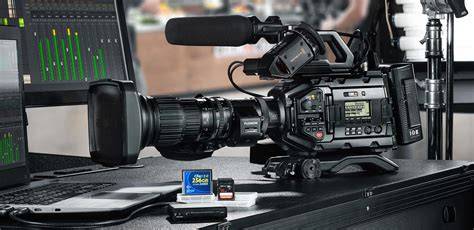
Key features at a glance include 12G-SDI, USB-C expansion, dual media slots, 13 stops of dynamic range, Blackmagic RAW and ProRes recording, B4 lens compatibility, and seamless ATEM integration for live production environments. The ergonomic design mirrors the URSA Mini Pro, while the B4-based workflow preserves familiar ENG habits like parfocal zooms and fast set-ups, making the URSA Broadcast a versatile bridge between traditional broadcast and modern digital cinema workflows.
Blackmagic URSA Broadcast Shooting Sample
For those evaluating a budget-friendly broadcast option, URSA Broadcast remains an appealing entry point: it delivers 4K/HD capabilities with a cinematic color science at a price point around $3,495 USD, with optional kits that add shoulder rigs, EVFs, and extended connectivity for live environments. The system’s flexibility is reinforced by the ability to swap lens mounts, leverage existing B4 glass, and integrate with Blackmagic’s ecosystem of cameras and switchers to create a cohesive production pipeline.
In summary, Blackmagic’s URSA Broadcast family, including the G2, stands out as a practical, scalable solution for producers who want broadcast-grade capabilities without abandoning the post-production workflows and color fidelity that come with Blackmagic RAW and DaVinci Resolve. It provides strong low-light performance, robust codec support, and a unique ability to pair Super 16-like sensors with modern B4 optics, all while staying deeply compatible with studio and field workflows.
- Record formats: ProRes, H.265, Blackmagic RAW
- Sensor: 13-stop dynamic range with 6K option in G2
- Lens options: B4 2/3" for ENG-style use; PL/EF for cinema lenses
- Media: Dual CFast 2.0 and dual SD/UHS-II
- Studio integration: ATEM control, talkback, tally, and program return
- Connectivity: 12G-SDI, USB-C, Ethernet on Pro models
tags: #blackmagic #broadcast #camera