Abstract: Feature upsampling is a key operation in a number of modern convolutional network architectures, e.g. feature pyramids. Its design is critical for dense prediction tasks such as object detection and semantic/instance segmentation. In this work, we propose Content-Aware ReAssembly of FEatures (CARAFE), a universal, lightweight and highly effective operator to fulfill this goal. CARAFE has several appealing properties: (1) Large field of view. Unlike previous works (e.g. bilinear interpolation) that only exploit sub-pixel neighborhood, CARAFE can aggregate contextual information within a large receptive field. (2) Content-aware handling. Instead of using a fixed kernel for all samples (e.g. deconvolution), CARAFE enables instance-specific content-aware handling, which generates adaptive kernels on-the-fly. (3) Lightweight and fast to compute. CARAFE introduces little computational overhead and can be readily integrated into modern network architectures. We conduct comprehensive evaluations on standard benchmarks in object detection, instance/semantic segmentation and inpainting. CARAFE shows consistent and substantial gains across all the tasks (1.2%, 1.3%, 1.8%, 1.1db respectively) with negligible computational overhead. It has great potential to serve as a strong building block for future research. It has great potential to serve as a strong building block for future research.
CARAFE presents a universal framework for upsampling features that combines a large receptive field with content-adaptive kernels. By reassembling features according to learned, position-specific kernels, CARAFE surpasses traditional fixed-kernel upsampling methods that fail to capture broader contextual cues. The approach addresses the limitations of bilinear or nearest-neighbor upsampling by modeling dependencies beyond local neighborhoods and dynamically tailoring the upsampling process to the content at hand.
Motivation and Design Principles
Dense prediction tasks require precise and context-aware feature enlargement. Fixed interpolation methods inherently neglect wider context and per-sample content, leading to suboptimal reconstructions in object boundaries and fine-grained regions. CARAFE targets three core principles: a large field of view to incorporate broader context, content-aware handling to generate adaptive kernels per sample, and lightweight computation to enable seamless integration into existing architectures.
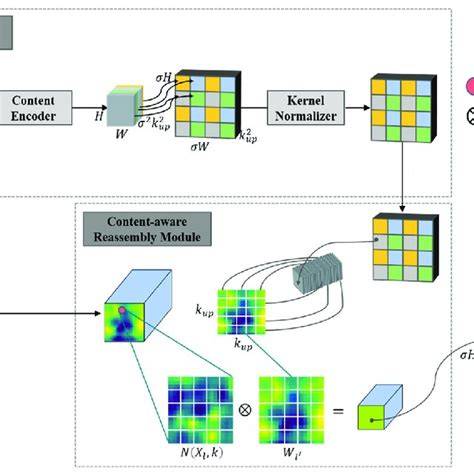
To realize these goals, CARAFE first predicts a compact reassembly kernel map from the input features, then expands that map into position-specific, content-aware kernels. These kernels are applied to reassemble low-resolution features into a higher-resolution representation, leveraging contextual information rather than relying solely on sub-pixel neighborhoods.
Technical Highlights
Large receptive field: CARAFE derives kernels that aggregate information across a broad region, enabling better preservation of structure and context during upsampling. This contrasts with traditional interpolation that uses a fixed, local neighborhood.
Instance-specific kernels: Instead of a universal upsampling kernel, CARAFE learns kernels conditioned on the content, allowing different samples to be upsampled with kernels tailored to their unique patterns and boundaries.
Efficiency: The operator introduces minimal computational overhead and is designed to be easily integrated into existing networks, making it attractive for practical deployment in large-scale models.
Empirical Evaluation
We conduct comprehensive evaluations on standard benchmarks across several vision tasks, including object detection, instance segmentation, semantic segmentation, and inpainting. CARAFE demonstrates consistent and substantial gains across all tasks, with improvements quantified as around 1.1-1.8 in diverse metrics, while incurring negligible additional computation. These results underline CARAFE’s potential as a robust building block for future research and deployment.
Comparative Analysis
Compared with bilinear or nearest-neighbor upsampling, CARAFE’s content-aware reassembly and broad contextual aggregation provide superior reconstruction quality, particularly around object boundaries and complex textures. The lightweight nature ensures compatibility with modern backbone networks and feature pyramids, preserving speed while boosting accuracy.
Applications and Implications
CARAFE is applicable to a wide range of dense prediction frameworks, including single-stage and multi-scale detectors, segmentation pipelines, and restoration/inpainting models. By enhancing the fidelity of upsampled features, CARAFE can contribute to more accurate localization, boundary delineation, and texture reconstruction in real-world scenarios.
Implementation Considerations
Integrating CARAFE into a network involves computing the content-aware kernels and applying them to reassemble features at the desired resolution. The design emphasizes modularity and compatibility with common deep learning libraries, enabling researchers and practitioners to adopt CARAFE with minimal architectural disruption.
Future directions may explore scaling the kernel prediction mechanism, combining CARAFE with attention-based modules, or extending the approach to temporal or multi-view data where cross-frame or cross-view consistency could further benefit upsampling quality.