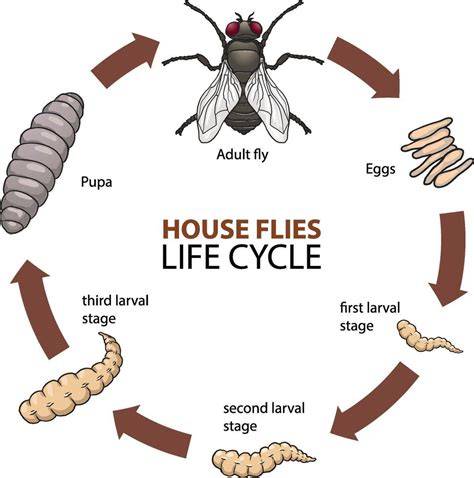
When it comes to a shared experience of dealing with bugs, flies are a universal problem that most homeowners have to overcome at some point. Flies aren’t only a frequent and common pest, but perhaps also one of the hardest infestations to control. Flies go through a four-phase lifecycle that varies on different factors of their current habitat. Although they can adapt to environments and can reproduce very quickly, the fly lifespan is relatively short.
Like most other insects, flies start their life as eggs. The common housefly lays eggs that look like little grains of white rice, but they can vary in shapes and sizes. Eggs are often laid in different locations that are protected and near food or decaying matter. Female flies can lay 100 eggs after the time of reproduction and can reproduce up to 5 to 6 batches in their lifetime. After hatching, these larvae (also known as maggots) turn into legless, white insects that feed at the site in which they hatched for three to five days. This stage is to focus on storing energy by eating in preparation for their next stage in the life cycle. They molt several different times throughout this stage before finding a dark place to pupate. During the pupae stage, the white larvae develop darker outer shells. Within a few hours after emerging from the pupa case, females can start breeding. Their shells are hard as they remain inactive for the next three to six days when the pupae develop legs and wings. The life expectancy of a housefly can range between 15 to 30 days. Factors like location, temperature, and living conditions can affect life expectancy. Flies that are found in warmer locations like homes or buildings develop faster and live longer than those living in the wild.
Flies are usually active during the daytime and stay close to where they were born. Because flies have such a fast life cycle, infestations can happen quickly. Eggs can be hard to look out for, especially when they’re in a hidden place like garbage or under other debris. Maggots are easier to spot in trash or food than eggs - and if you find maggots, that usually means eggs are present as well. If you find maggots in the food or the trash, you can boil them to eliminate them. Sprinkling salt or an insecticide on them can also help you get rid of them.
After you eliminate the breeding site, focusing on the adult flies in the area is next. Remember, they breed very fast so it’s important to act immediately. Fly traps are a great product to use to catch the remaining flies around the outside of your home. Using bait to attract the flies while then capturing them inside the trap with a strong lid, you can reuse this trap until your infestation outdoors is gone. As for indoor control, catch those pests flying around your home with our Indoor Trap. Discreet and decorative, this trap attracts flies with bait and then traps them so they can’t escape. As for an outdoor solution, our Garbage Guard® Trash Can Insect Killer is a great option to use with your outdoor garbage cans. Garbage cans are one of the more popular areas in which flies like to frequent due to the unlimited food and waste. Aim to prevent and eliminate flies surrounding your garbage cans by placing the pod on the inside of your bin’s lid. It’s much easier to prevent flies before they start infesting your home.
That’s why we make products that help you take care of flies and other insects at every stage of life so that you don’t have to deal with them in and around your home. The answer is not quite as straightforward as you might think. In most flies, including the housefly, which buzzes around beneath light-fittings worldwide, the male mounts the female from behind. In a departure from zoological convention, though, it is the female housefly that penetrates the male, using her egg-laying tube, or ovipositor. Another familiar group, the crane flies, tend to face in opposite directions, joined only by the tips of their elongated abdomens. Our experts answer a range of fly-related questions, including why do flies rub their legs together?, why are adult crane flies too busy to eat? and why do flies get into ointments.
Flies have potential to harm humans and animals by spreading diseases such as food poisoning and dysentery. They contaminate surfaces by landing on them and regurgitating stomach contents onto food to liquefy it before ingesting it. One of the largest groups of insects, flies are found in moist organic material upon which they lay their eggs. They are relatively small, soft-bodied insects with large eyes, strong fliers, and a striped thorax. Eggs are laid on animal feces and garbage, hatch from the eggs and grow to about ½ inch, and crawl away from their food source to undergo the pupal stage. Dead animals can cause carrion to have a bloated appearance, and flies are attracted to garbage. Common species have three dark stripes on the thorax and an abdomen that varies in color from gray to black.
House flies are usually gray in appearance and display four black stripes on their thorax. Adult house flies are about 1/8-1/4” (4 to 7.5 mm) long with slightly hairy bodies, a single pair of wings and compound red eyes. Female house flies are usually larger than males. House fly eggs resemble small grains of rice and hatch into larvae, which range in size from about ¼-3/8” (7-10 mm) long. Maggots are cream colored with a greasy appearance. When entering the pupal stage, maggots develop dark, hard outer shells, legs and wings, ultimately emerging as full-grown adult flies. Depending on conditions, the developmental time from egg to adult may require as little as six days. The life cycle begins when a fertilized female house fly finds a suitable location to lay her eggs, oftentimes on feces, carrion or garbage. She will reproduce about 5-6 times, laying batches of about 100 eggs during each round. Female house flies usually only mate once but are capable of producing between 350-900 eggs in their lifetime.
How do you control an infestation? The eggs, which are white and about 1.2 mm in length, can hatch in 12-24 hours in warm weather. Pale-whitish larvae emerge from the eggs and grow to 3-9 mm long, feeding at the egg-laying site for three to five days. At the conclusion of this period, larvae seek out a dark, dry and cool environment to pupate. Over the course of three to six days, the pupae develop legs and wings, and grow into fully-grown adult house flies. After two to three days, the adult female house flies are fully ready and able to reproduce, restarting the life cycle. House flies are usually only active during the daytime, and they enter from outside, with interior breeding sites being less common. Regular sanitation, sealed garbage receptacles, and proper screening are essential to deter entry and reproduction. If a home experiences a significant fly problem, a licensed pest control professional can conduct an inspection and provide treatment methods to remove them and prevent future breeding sites.
Where do flies lay eggs and how do life stages unfold?
Where do flies lay eggs? Moist, decaying organic material is the preferred spot for a female house fly’s breeding grounds. In her lifetime, female flies don’t hold back on their reproductive duties, as they lay 500 eggs at a time across multiple batches. Once born, the larvae, known as maggots, don’t have to venture far for sustenance. Their birthplace, abundant in decomposing materials, fuels their growth and development. Fruit flies seek out the sweetness of fermentation, laying their eggs in the rotting produce. Drain flies inhabit plumbing systems and can endure low-oxygen environments. These varied breeding preferences highlight the adaptability of flies to almost any environment that contains their preferred source of decay. Understanding these preferences allows us to better target our efforts in controlling fly populations.
If you want to stop a fly infestation from getting out of hand, you need to make sure you create an undesirable environment for raising the young. When fly infestations become too much to handle, your best bet is to bring in the professionals, especially if you’ve already got fly eggs waiting to hatch. Our team at Dodson Pest Control implements strategies tailored to the specific species and life cycles of the flies involved in your unique situation.
What is the life cycle of a house fly? Egg → Maggot → Pupae → Full grown house fly. A female can lay up to 150 eggs in a batch and produce five or six batches in a few days. How do flies reproduce? Within two to three days after being born from a pupae, female house flies are capable of reproduction, using oviposition. Where do flies lay eggs? Damp, dark surfaces such as compost, manure and other decomposing organic material are favored. What do fly eggs look like? They resemble grains of rice. What is a fly pupa? Pupae are hard, brown shells protecting developing flies, with legs and wings forming inside. Do maggots turn into flies? Yes, maggots metamorphose into adult flies through pupation. If you encounter maggots or eggs, address breeding sites promptly and consider professional help for comprehensive control.
- Identify breeding sites with sanitation as a cornerstone.
- Eliminate maggots with safe treatment and disposal of breeding materials.
- Install traps indoors and outdoors to reduce adult populations.
- Seal entry points and maintain clean, covered waste containers.
- Consult licensed pest professionals for persistent infestations.