Final Cut Pro (often abbreviated FCP or FCPX) is a professional non-linear video-editing application initially developed by Macromedia, and, since 1998, by Apple as part of its pro apps and Creator Studio collection for macOS and iPadOS. Final Cut Pro allows users to import, edit, and process video footage, and output it to a wide variety of formats.
In the 2000s, Final Cut Pro developed a large and expanding user base, mainly video hobbyists and independent filmmakers. It also made inroads with film and television editors who have traditionally used Avid Media Composer. According to a 2007 SCRI study, Final Cut Pro made up 49% of the United States professional editing market, with Avid at 22%.
A published survey in 2008 by the American Cinema Editors Guild placed their users at 21% Final Cut Pro (and growing from previous surveys of this group), while all others were on an Avid system of some kind. In 2011, Final Cut Pro 7 was replaced with the fully rewritten Final Cut Pro X, which initially lacked many features from previous versions, though frequent updates have brought back many of these features.
Final Cut Pro provides non-linear, non-destructive editing of any QuickTime-compatible video format including DV, HDV, P2 MXF (DVCProHD), XDCAM (via plug-in), 2K, 4K, 5K, and 8K film formats and can import projects directly from iMovie for iOS and iPadOS. It supports a number of simultaneously composited video tracks (limited mainly by video form capability); unlimited audio tracks; multi-camera editing for combining video from multiple camera sources (referred to as angles); 360º video editing support; as well as the standard ripple, roll, slip, slide, scrub, razor blade and time remapping edit functions.
It comes with a range of video transitions and a range of video and audio filters such as keying tools, mattes and vocal de-poppers and de-essers. The functionality of Final Cut Pro can be extended with plug-ins which may provide additional effects, titles, transitions, and more. Event browser: Replacing “bins” in other NLEs, the event browser is where the original media is found and can be searched and sorted by various forms of metadata.
Magnetic timeline: Inventing an alternative to track-based timelines found in traditional NLEs, Final Cut's magnetic timeline uses clip connections to keep connected clips and secondary storylines in sync with clips located on the primary storyline. By default, clips move around each other "magnetically", filling in any gaps and avoiding clip collisions by automatically bumping clips out of the way vertically. Roles: In order to separate and organize different audio types on the magnetic timeline, editors can designate what "role' each clip plays. Introduced in version 10.0.1, Roles can be assigned to clips as an alternate way of creating organizational functionality. A Role (or Sub-Role) gets assigned to clips to identify what it is (for example Video, Titles, Dialogue, Effects, Music).
Content auto-analysis: Found in the import window and event browser is the option to analyze media for shot type and facial recognition or fix potential problems like audio loudness, audio hum, channel grouping, background noise, color balance, pulldown removal, and stabilization. Compound clips: Nested sequences from the original Final Cut Pro have been replaced by compound clips. A selection of video and audio clips can be nested into a single compound clip. This compound clip can be opened in its own timeline or broken apart for further editing. Multicam editing: Introduced in version 10.0.3, multiple camera angles can be synchronized automatically and combined into a multicam clip. Once in the timeline, a multicam clip can be cut up into different angles by using the angle viewer. Auditions: Clips can be grouped together in the event browser or on the timeline as auditions. 3D titles: Introduced in version 10.2.0, text can be extruded, textured, lit, and shaded with materials and environments in 3D. 360 degree video editing: Introduced in version 10.4. While inheriting the name from its predecessor, Final Cut Pro, Final Cut Pro X is a completely re-written application.
As a native 64-bit application it takes advantage of more than 4GB of RAM. It utilizes all CPU cores with Grand Central Dispatch. Open CL support allows GPU accelerated processing for improved performance for playback, rendering, and transcoding. It is resolution-independent, supporting images sizes from SD to beyond 4K. Titles, motion graphics, effects generated in Motion 5 can be published to Final Cut Pro X.
In Final Cut Pro X 10.0.3 and later, the editor can import Photoshop projects onto the storyline similar to a still image. A Photoshop project with layers is treated similar to a compound clip and the layers are preserved after being imported into the Final Cut Pro X. Individual layers of the Photoshop project can be toggled on or off inside the Final Cut Pro X by double-clicking the imported project and going into the compound clip editing panel.
Since its release, Final Cut Pro X has supported the construction of effect, transition, and title plugins by publishing custom-built effects from Apple Motion. Randy Ubillos led the team that developed the first three versions of Adobe Premiere. His group was then hired by Macromedia to develop KeyGrip, a more professional video editing program based on Apple's QuickTime, for Macromedia. Niya C Sisk was retained by Macromedia to create the UI of KeyGrip in partnership with the engineering team. However, Macromedia was unable to release the product, since they had licensed a component from Truevision, and the latter had a licensing agreement with Microsoft that prohibited the component's use in conjunction with QuickTime.
In 1998, KeyGrip was renamed Final Cut, and was demonstrated as a 0.9 alpha in a private room at the NAB Show. The demonstration showed both Mac and Windows versions of the software, with the Mac version using a Truevision RTX dual-stream real-time card with limited real-time effects. When no buyer was found for the program, Apple acquired the development team as a defensive measure. To ensure that Final Cut Pro had strong support for third-party self-paced and instructor-led training from the start, Apple partnered with DVcreators.net to release a training disc called "Final Cut Pro PowerStart" at the NAB show on the day of Final Cut Pro's release.
After the release of Final Cut Pro, Adobe Premiere maintained a strong market share on Windows, but began to decline on Mac as its older codebase was more difficult to maintain. One of the factors that contributed to the success of Final Cut Pro was the relative maturity of QuickTime and its native support for new DV cameras connected via FireWire. The first fully broadcast quality, globally distributed TV show produced using Final Cut Pro was Women of Wrestling in 2000, which used the Pinnacle CinéWave uncompressed video card.
In late 2001, independent producer Michael A. Bloom credited Final Cut Pro as being crucial to the production of his controversial film PlayCouples, A New Era of Swinging (2003). In an interview with Larry King, Bloom claimed that the relatively new platform did not fail once while rendering the film, unlike his experiences with Avid Media Composer. The studio motion picture The Rules of Attraction was also edited using beta versions of Final Cut Pro 3, demonstrating that successful 3:2 pulldown matchback to 24fps was possible with an easy-to-use software product. The film's director, Roger Avary, became a spokesperson for Final Cut Pro, appearing in print advertisements worldwide. His endorsement of the product helped to give mainstream editors like Walter Murch confidence in its readiness for professional use.
Final Cut Pro 4 was released in April 2002, and included three new applications: Compressor for transcoding between video formats, LiveType for advanced titling (such as the creation of animated lower thirds), and Soundtrack for creating royalty-free music soundtracks. In April 2004, Final Cut Pro 4.5 was released and branded as "Final Cut Pro HD" due to its native support for Panasonic's tape-based DVCPRO HD format for compressed 720p and 1080i HD over FireWire. Final Cut Pro 5 was announced at a pre-NAB event in April 2005 and shipped in May of that year. It added support for the HDV format for compressed HD, which had previously been supported in Final Cut Pro's scaled-down cousin, Final Cut Express. In January 2006, Apple stopped selling Final Cut Pro as a standalone product and began offering it only as part of the Final Cut Studio bundle.
In March 2006, a universal binary 5.1 version of Final Cut Pro was released as part of Final Cut Studio, and upgrades were made available by sending the original installation discs back to Apple with a fee. On April 15, 2007, Apple unveiled Final Cut Pro 6 as the centerpiece of the Final Cut Studio 2 bundle. Final Cut Pro X was unveiled on April 12, 2011 at the NAB Show, and released to the Mac App Store on June 21, 2011 along with new versions of Motion and Compressor. Final Cut Pro X was fully-rewritten in 64-bit, with a new interface, workflow enhancements and improved automation, and new features such as ColorSync integration, a resolution-independent playback system, and Core Animation-based system scaling.
The reaction was extremely mixed, with veteran film editor Walter Murch initially refusing to use it, citing a lack of features compared to Final Cut Pro 7. Support for translating timelines from Final Cut Pro 7 to Final Cut Pro X was notably missing, requiring editors to preserve a copy of Final Cut Pro 7 to edit older projects. An online petition asking Apple to continue development of Final Cut Pro 7 or to sell it to a third-party gathered 1,600 signatures within a week. Some of the missing features in Final Cut Pro X that were essential for professional video production included the lack of an edit decision list (EDL), XML and Open Media Framework Interchange (OMF) support, the inability to import projects created in previous versions of Final Cut Pro, the absence of a multicam editing tool, missing support for third-party I/O hardware output, and videotape capture being limited to FireWire video devices, including capture with third-party hardware. These missing features were addressed within the first six months of the product's life. EDL export, a product of the early days of videotape editing, is now supported through third-party software and creating an AAF (a newer version of OMF) for passing projects to Pro Tools through X2Pro.
One of the notable changes introduced in Final Cut Pro X was the Magnetic Timeline, which replaced the track-based timeline of previous versions. With version 10.0.6 released on October 23, 2012, Apple added native support for Redcode Raw and MXF through a third party plugin. Prior to the introduction of version 10.1, Project and Event Libraries were separate folders. Events contained all the original media and Project Libraries contained the actual edited Projects on timelines. The Project and Event Libraries were stored in a user's Movie folder or on the root level of an external hard drive. These Libraries automatically opened in Final Cut Pro X depending on which hard drives were mounted. That all changed on December 19, 2013, when Project and Event Libraries were merged into a new Library model. Libraries contained Events which in turn contained Projects. And unlike before Libraries could be opened and closed by the user. Media could be stored internally in the Library or kept outside the Library.
Version 10.2, released during the NAB Show 2015, introduced 3D Titles in both Final Cut Pro X and Motion. Version 10.4 introduced color wheels and color curves, 360º video editing, and high-dynamic-range (HDR) video, and the HEVC and HEIF formats. In April 2018, Apple said that there were more than 2.5 million users of Final Cut Pro X. In version 10.4.1, released during the NAB Show 2018, closed captioning was added, along with support for ProRes RAW. Unified import window. Apply LUT corrections to view log footage from Arri, Blackmagic, Canon and Sony Cameras in Rec. Unlock even more controls for ProRes RAW video shot on iPhone, so you can adjust exposure, color temperature, tint, and demosaicing. Removes support for FireWire-connected devices on macOS Tahoe. Final Cut Pro for iPad was released on May 23, 2023.
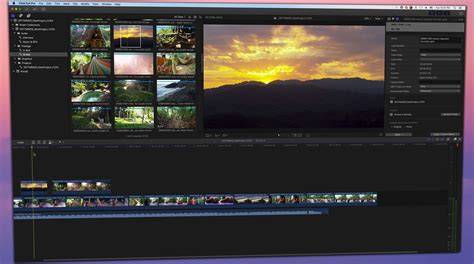
Final Cut Pro is primarily a macOS and iPadOS application, with the native macOS architecture and Apple ecosystem integration shaping its core design and feature set.
Its cross-platform availability has historically been limited, and professional workflows beyond macOS have largely depended on alternate editors such as Avid or Adobe Premiere on non-Mac systems.
In summary, Final Cut Pro originated on Mac, was rebuilt as Final Cut Pro X for macOS and iPadOS, and remains a Mac-centric tool with a rich history of professional adoption, continuous updates, and ecosystem-specific features. While there were early discussions and third-party attempts to bring similar capabilities to Windows, Final Cut Pro itself has not become an officially supported Windows application.
| Version | Release Notes | Platform |
|---|---|---|
| Final Cut Pro | Legacy timelines, original tools | macOS |
| Final Cut Pro X | 64-bit rewrite, Magnetic Timeline, new library model | macOS, iPadOS |