Talking about Leonardo da Vinci means delving into the roots of the Renaissance and reconstructing his character by contextualizing him at the dawn of the scientific revolution that will transform the vision of the modern world. Leonardo had immediate fortunes as a painter but over time he was appreciated for his extraordinary personality. Skilled and affable conversationalist, described by historians as very handsome, tall, well dressed, even extravagantly with clothes that he designed himself, he knew how to range in many genres of human interest. Legends were born around him, still cultivated today, which find fruitful aspirations in the interpretation of his designs.
Let’s think, for example, of Leonardo’s first work. Vasari, a historian of 1500, says that Leonardo, having to decorate a wooden shield at the request of his father, decided to represent a winged monster as an effigy. To do it in the most realistic way possible, he combined distinct parts of dead animals and insects, such as lizards, grasshoppers, snakes, and crickets without even noticing the stench they emanated, such was the artistic passion that moved him. The father, struck by the realism of the work, sold the shield for one hundred ducats to merchants who, in turn, sold it to the Duke of Milan for three hundred ducats. This was the first known work of Leonardo da Vinci, a work that revealed his aptitude for combining imagination and observation, a gift that accompanied him throughout his life.
Leonardo is a willing and helpful young man and immediately understands that he can redeem himself from his condition as an illegitimate son by learning as much as possible to master the various artistic disciplines: from painting to sculpture, from Goldsmithing to architecture to be able to attend the most important Italian courts. Which only the best artists could access. In a short time, his skill surpasses that of the master. Vasari says that Verrocchio, having commissioned the young assistant Leonardo to paint one of the angels of the Baptism of Christ, was amazed by the beauty of the result, so much so that he said he no longer wanted to pick up a brush, almost resentful that a boy she knew more than him. When Leonardo Da Vinci leaves Verrocchio’s workshop, Ludovico il Moro calls him to Milan. Curiously, he presents himself as an excellent singer and musician, carrying with him a gold lyre with a bow, built by him, in the shape of a horse’s head.
Here begins a period of intense work, not only artistic, but also technological and military, and Leonardo opens his own workshop surrounding himself with young students. One in particular catch his attention: the beautiful, but lively and turbulent Gian Giacomo Caprotti known as Salaì, from the term Saladino which means devil. Often used as a model, he seems to be the one to give the face, in the following years, to San Giovanni Battista. Among the various and important works commissioned from Leonardo Da Vinci in this period, the stenographic arrangements of the court parties at The Palazzo Sforza stand out for their originality. One of these, for the celebration of the marriage between Gian Galeazzo Sforza and Isabella d’Este, is the Feast of Paradise, in which the seven known planets then turned, personified by poets who praised the Duchess Isabella. While dedicating himself to the creation of the famous horse, he also works on the decorations of the Sala delle Asse of the Castello Sforzesco and on the Last Supper in the refectory of Santa Maria delle Grazie. As a gesture of gratitude for the various works created for Ludovico il Moro, he receives as a gift from him a vineyard of sixteen Milanese “pertica”, about one hectare, in the Porta Vercellina area.
The historical events of the early sixteenth century led Leonardo to pass from one commission to another: from the Medici, lords of Florence, to the powerful Borgias of Rome, up to the Amboise, new governors of Milan. He broadened his knowledge in the fields of architecture, town planning and hydraulics, even designing innovative solutions to make the Milanese Navigli navigable. In this period, he is accompanied by Francesco Melzi who will become one of his most faithful students, remaining with him until his death in Amboise. Upon the death of Giuliano de’ Medici, Leonardo accepted the invitation of the French king Francis I, who entrusted him with the task of designing his new royal residence. Later the King of France offered Leonardo a residence at the Castle of Clos Lucé and an annuity, he admired him as an artist but also as a philosopher.
On April 23, 1519, Leonardo summons the royal notary bureau to dictate his will. He leaves nothing to chance. He gives a detailed description of his legacies and how his funeral will be carried out, the choice of the church of Saint Florentin in Amboise and the funeral procession that will be opened by the rector and the prior of the church, accompanied by 60 poor people, each with a torch in hand, each of which will be paid 70 money tornesi. After the ceremony, three large and thirty low masses must be celebrated according to the Gregorian rite. Although he has since been celebrated for his technological ingenuity, Leonardo’s scientific genius largely went undiscovered and unappreciated during his time.
Early life and training
The possible birthplace and childhood home of Leonardo in Anchiano, Vinci, Italy. His illegitimacy meant he was not expected to follow his father’s profession and become notary. His artistic talents were evident from an early age. In 1478, Leonardo received his first independent commission: to paint an alterpiece for the Chapel of St. However he was forced to abandon both commissions when he relocated to Milan to work for the Sforza family. The Baptism of Christ (1472-1475) by Verrocchio and Leonardo, Uffizi Gallery.
Leonardo spent nearly 17 years planning the statue. Leonardo was not a prolific painter. Study for The Battle of Anghiari (now lost), c. 1503, Museum of Fine Arts, Budapest. In 1476, Leonardo and three other young men were charged with the crime of sodomy in an incident that involved a well-known male prostitute. Early years: Painter, sculptor, architect, designer, theorist, engineer and scientist, Leonardo da Vinci created some of the most famous images in European art. Though many of his works were never finished, and even fewer have survived, he influenced generations of artists and he continues to be revered as a universal genius.
Major works and genius
Leonardo was born near the Tuscan hill-town of Vinci. An illegitimate child, he was raised by his paternal grandfather. His father had a flourishing legal practice in the city of Florence, where Leonardo received his early artistic training with the sculptor Andrea Verrocchio. Verrocchio's workshop undertook a wide range of commissions including sculpture and decorative metalwork as well as paintings. By 1483, Leonardo felt stifled and decided that Milan would offer more exciting opportunities. He wrote to the ruling family, the Sforzas, asking for employment primarily on the grounds that he was an expert in military engineering. Soon after his move to Milan, a confraternity commissioned an altarpiece, and Leonardo created The Virgin of the Rocks. When they refused to give what he considered a fair price for the painting, he sold it to someone else in disgust and it was some years before the confraternity could persuade him to do a second version-the one that now hangs in the National Gallery.
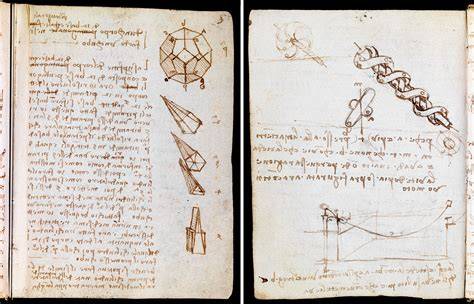
The notebooks: Leonardo kept notebooks of his research into science, biology, anatomy, engineering and art. The books were filled with drawings and diagrams, and covered with notes written in mirror handwriting and he kept them for the rest of his life. Leonardo's major artistic achievement at this time was his depiction of The Last Supper, which he painted for the wall of the refectory of Santa Maria delle Grazie. The Last Supper perfectly illustrates Leonardo's belief that poses, gestures and facial expressions should reflect the motions of the mind. In Milan, he also painted the Virgin of the Rocks for the Confraternity of the Immaculate Conception and experimented with anatomical and mechanical ideas that would influence his later works.
Florence, Milan, Rome and France: In 1499 the French army invaded Milan and Leonardo returned to Florence. He was fascinated by the mystery of the face and by the possibility of reading the motions of the soul through facial expressions and gesture. Leonardo's portrait of the wife of a Florentine official, known as the Mona Lisa, is famous for its sitter's enigmatic expression. Leonardo soon tired of Florence, and by the summer of 1508 he was back in Milan, working for the French rulers of the city. He began work on a series of compositions of the Virgin and Child. The Burlington House Cartoon is a preparatory work for a painting now in the Louvre, Paris. This second period in Milan lasted until 1513 and was followed by three years in Rome. At some point during this period he was brought to the attention of the French king and was offered employment as 'first painter and engineer' at the royal court. Leonardo accepted the offer and in 1517 he moved to the Chateau of Cloux, near Amboise, where he spent the rest of his life.
Final years and legacy: Towards the end of his life, Leonardo was plagued by ill-health and a stroke left him paralysed down the right side of his body. He practised botany in the Vatican Gardens, and was commissioned to make plans for the Pope's proposed draining of the Pontine Marshes. He also dissected cadavers, making notes for a treatise on vocal cords; these he gave to an official in hopes of regaining the Pope's favour, but he was unsuccessful. Leonardo died at Clos Lucé on 2 May 1519 at the age of 67, possibly of a stroke. Francis I had become a close friend. Vasari describes Leonardo as lamenting on his deathbed that he had offended against God and men by failing to practice his art as he should have done. The King held Leonardo's head in his arms as he died, though this story may be legend. His notebooks and paintings influenced generations of artists and scientists, affirming his status as a polymath and a founder of many principles of the High Renaissance.
Impact and reception
Leonardo first gained attention for his work on the Baptism of Christ, painted in conjunction with Verrocchio. Two other paintings appear to date from his time at Verrocchio's workshop: the Annunciations, including a predella and a larger panel, which demonstrate his early mastery of composition and anatomy. He centered the Virgin and Christ child in the scene in the 1480s, improving on standard practices of perspective by refining clarity and color as objects receded. In Milan, he combined stage design, military engineering and painting, laying groundwork for his enduring legacy in multiple disciplines. His approach to invention-combining observation, anatomy and geometry-set a standard for later scientists and artists alike, and his portraiture, especially the Mona Lisa, continues to captivate audiences worldwide.
Leonardo’s drawings and notebooks reveal a mind that sought to understand how things work, from flight to hydraulics to human anatomy. Though many projects remained unfinished, his influence persisted through pupils and imitators who carried his methods forward. His legacy endures in the fusion of art and science, a hallmark of the Renaissance that reshaped already-seen boundaries of knowledge and creativity.