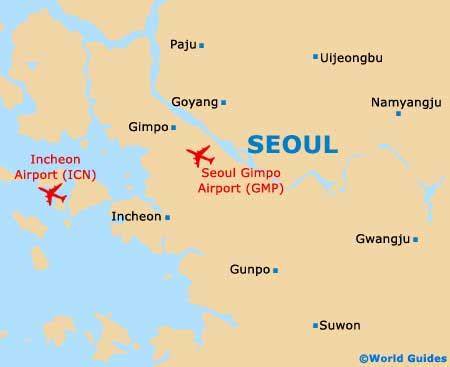
Gimpo International Airport (GMP) is the smaller of Seoul’s two international airports and serves primarily domestic and inter-Asia international flights. Gimpo was Seoul’s only major international airport until Incheon International Airport opened in 2001. Location Of the two Seoul airports, Gimpo is the nearest one to the city center, about 10 miles away. Its proximity makes it a go-to airport for locals traveling to other parts of South Korea like Busan, Jeju Island, and Daegu. It’s also a popular choice for people who want to hop over to cities in Japan like Tokyo and Osaka, or to Shanghai in China. Visitors can fly to and from the US through Gimpo, but it will most likely involve a layover and cost significantly more than flying in and out of Incheon.
Historical milestones and development
Gimpo previously carried the IATA airport code SEL, which is now used by airline reservation systems and travel agencies within the Seoul metropolitan area, and was the main international airport for Seoul and South Korea before being replaced by Incheon International Airport in 2001. The airfield was built in 1939 during the Japanese Imperial period as an Imperial Army base. North Korean forces attacked South Korea on 25 June 1950 starting the Korean War. During one of the first Korean People’s Air Force (KPAF) attacks on 25 June, a Military Air Transport Service C-54 Skymaster was destroyed on the ground at Gimpo. On 27 June, US naval and air forces began evacuating 748 US diplomats, military dependents, and civilians by air transport from Kimpo and Suwon Airfield. Gimpo was captured by the KPA shortly after the capture of Seoul on 28 June 1950. On 29 June, eight B-29s of the 19th Bomb Group bombed Gimpo and the Seoul railyards. By July, the KPAF were using the base for attacks on UN forces; on 10 July, seven Yak-7s were hidden at Gimpo and used in strikes against UN positions at Cheongju. The next day, they surprised and damaged several Lockheed F-80s in the area. Following the Inchon landings on 15 September 1950, the 2nd Battalion 5th Marines was ordered to seize Gimpo on 17 September. Gimpo was defended by a conglomeration of half-trained fighting men and service forces, and by the morning of 18 September, the Marines had secured the airfield. Army Corps of Engineers repaired the local railroad up to 13 kilometres inland and 32 C-54 transport planes began flying in gasoline and ordnance. VMF-212 was one of the first units to operate from Gimpo before moving forward to Yonpo Airfield. UN forces resumed the offensive again in late January 1951 and launched Operation Thunderbolt on 25 January, with the aim of pushing Chinese and North Korean forces back north of the Han River.
Eventually, the South Korean government decided to build a new airport. The facility was initially planned to be in Cheongju, 124 kilometres away from Seoul, but that idea was strongly opposed by the citizens of Seoul and Gyeonggi Province, due to the inconvenience it would pose to them. Finally, Yeongjong Island, a part of the city of Incheon, slightly west of Seoul, was chosen for the new airport, which later came to be known as Incheon International Airport. On 22 February 1957, a USAF Douglas C-124 Globemaster II crashed near SEL after takeoff because of a prop/turbine blade separation, resulting in a forced landing in the Han River. On 19 November 1980, Korean Air Lines Flight 015, a Boeing 747-200 landed short of the runway, ripping off all main landing gear, causing the aircraft to skid to a stop on the nose wheel and outer two engines starting a fire. On 25 November 1989, Korean Air Flight 175, a Fokker F28-4000 en route to Ulsan Airport crashed right after takeoff. On 5 August 1998, Korean Air Flight 8702, a Boeing 747-400, rolled off the runway upon touchdown and slid into a ditch, resulting in the destruction of the aircraft’s undercarriage and the fuselage being split.
Transition to Incheon and Gimpo’s current role
After the opening of Incheon Airport in 2001, Gimpo began to focus on “shuttle” flights to cities like Tokyo, with plans for expansion and the construction of a new terminal to meet domestic demand. In 2003, regular flights to Haneda Airport in Tokyo resumed, followed by flights to Shanghai Hongqiao International Airport in 2007 and Kansai International Airport in Osaka in 2008. In 2015 Gimpo received 23,163,778 passengers, making it the third largest airport in South Korea by passenger traffic. Today, Gimpo serves primarily domestic and inter-Asia international flights, complementing Incheon as Seoul’s international hub.
Terminals and facilities
Gimpo has two terminals: one for domestic flights and one for international flights. The domestic terminal handles inter-Korean and domestic routes serviced by Korean Air, Asiana Airlines, Air Busan, Jeju Air, T’way Air, and Jin Air. The international terminal serves international airlines like Japan Airlines, China Eastern Airlines, All Nippon Airways, and various South Korean carriers flying to regional and international destinations. Passengers arriving at Gimpo’s international terminal must go through immigration. A shuttle bus connects the two terminals for convenience.
Getting to and around Gimpo
Gimpo International Airport is accessible by AREX, Line 5, and Line 9 of the Seoul Metro, as well as by various bus routes. The AREX line from Seoul Station (all-stop train) connects to both Gimpo and Incheon and typically takes about 20-30 minutes to Gimpo. Line 5 and Line 9 provide convenient rail options, with Line 9 offering express service in some segments. Rideshare, taxi, and bus options are available if you’re starting from other parts of Seoul or beyond. Depending on your starting point, you may need to walk some distance within the terminals to reach check-in or security.
What to do at Gimpo
Gimpo’s smaller footprint means shorter wait times and a more compact experience compared to Incheon. If you arrive via subway, you can pass by the Lotte Mall on the way, featuring stores, supermarkets, and a movie theater. Inside the international terminal, there are duty-free shops at Lotte and Shilla and a small food court. For coffee, there’s a limited option past security, so grab a caffeine fix beforehand if needed. The domestic terminal offers fewer dining options but convenient spots like Gong-Cha for brown sugar boba and Designskin for K-beauty products.
Incheon International Airport as a contrast
Incheon International Airport (ICN) is the main international hub for South Korea, known for its modern design, extensive shopping, and cultural experiences. Terminal 1 hosts major international airlines and luxury brands, while Terminal 2 serves SkyTeam airlines and features an observation deck. AREX provides easy access from central Seoul, with Express and all-stop options depending on your plan. For long layovers or early flights, Incheon offers Transit Hotel in Terminal 2 and Spa on Air in Terminal 1 for relaxation and rest.
Choosing the best Seoul airport for your trip
The best Seoul airport to fly in and out of depends on your destination. If you’re visiting other parts of South Korea or nearby cities in Japan and China, Gimpo is often more convenient due to proximity to the city center, shorter wait times, and domestic-focused routes. For international trips beyond neighboring countries, Incheon is typically the primary gateway.
- Gimpo is ideal for domestic and short-haul inter-Asia flights.
- Incheon is ideal for long-haul international flights and broader global connections.
The Free Layover Tour at Incheon International Airport (ICN)
Gimpo and Incheon together provide seamless access to and from Seoul, offering a mix of domestic routes, regional connections, and international accessibility that suits a wide range of travelers.