The Creation of Adam (Italian: Creazione di Adamo), also known as The Creation of Man, plate 54 is a fresco painting by Italian artist Michelangelo, which forms part of the Sistine Chapel's ceiling, painted 1508-1512. It illustrates the Biblical creation narrative from the Book of Genesis in which God gives life to Adam, the first man.
Michelangelo painted the ceiling of the Sistine Chapel; the work took approximately four years to complete (1508-1512). In 1505, Michelangelo was invited back to Rome by the newly elected Pope Julius II. Under the patronage of the Pope, Michelangelo experienced constant interruptions to his work on the tomb in order to accomplish numerous other tasks. Although Michelangelo worked on the tomb for 40 years, it was never finished to his satisfaction.
It is located in the Church of S. The composition stretches over 45 ft. × 128 ft. (more than 500 square metres) of ceiling, and contains over 300 figures. At its centre are nine episodes from the Book of Genesis, divided into three groups: God's creation of the world; God's creation of man and his fall from God's grace; and lastly, the state of humanity and sin as represented by Noah and his family.
God is depicted as an elderly white-bearded man, wrapped in a swirling cloak while Adam, on the lower left, is completely naked. God's right arm is outstretched to impart the spark of life from his own finger into that of Adam, who is actually already created but inert. Adam's left arm is extended in a pose mirroring God's, a reminder that God said, "Let us make humankind in our image, according to our likeness." Many hypotheses have been formulated regarding the identity and meaning of the twelve figures around God.
Michelangelo's main source of inspiration for his Adam in his Creation of Adam may have been a cameo showing a nude Augustus Caesar riding sidesaddle on a Capricorn. This cameo is now at Alnwick Castle in Northumberland, England. The cameo used to belong to cardinal Domenico Grimani who lived in Rome while Michelangelo painted the ceiling. In February 2026, I.A. Pireev published a study entitled "Michelangelo. The Brain. Biochemistry of Religions," arguing a fundamentally different conceptual vision of Michelangelo's design, suggesting the fresco reflects the human perception system based on the five basic senses and Aristotle's “three-ventricle” theory. Five Angels are singled out with corresponding functions, and the contours of God's left hand are said to correspond to the middle ventricle of the brain, with the central Angel symbolizing the sens communis. This theory sits alongside other interpretations that emerged in later scholarship.
There is significant evidence that Michelangelo radically disagreed with many Catholic traditions and had a tumultuous relationship with the commissioner of the ceiling, Pope Julius II. Michelangelo completed two sketches in Rome in preparation for the Creation of Adam scene. The first is a Scheme for the Decoration of the Vault of the Sistine Chapel: Studies of Arms and Hands. The right side of the page was sketched in 1508 with black chalk, and is a study of Adam's limp hand, before it is ignited with the gift of life from God, in the Creation of Adam scene. The second sketch is titled Studies of a Reclining Male Nude: Adam in the Fresco "The Creation of Man." It was created in 1511 in dark red chalk, over a stylus under drawing.
In Michelangelo's final fresco on the ceiling, Adam is physically beautiful, but spiritually still incomplete. The sketch prefaces this story, as it is also incomplete in the sense that the only complete component of the drawing is Adam's twisted torso. The Belvedere Torso is believed to have inspired the torso in the British Museum sketch. The Belvedere Torso is a fragmentary marble statue that is a 1st-century BC Roman copy of an ancient Greek sculpture. The Adam of the Sistine Chapel is unlike them in a total absence of that balance and completeness which express so well the sentiment of a self-contained, independent life. In that languid figure there is something rude and satyr-like, something akin to the rugged hillside on which it lies.
The Creation of Adam is a fresco painted around 1512 on the ceiling of the Sistine Chapel in the Vatican. God reaches toward Adam, their fingers almost meeting. The gap between them is the whole point: the spark of life is about to jump, and has not jumped yet. Michelangelo’s two hands reaching toward each other have become one of the most reproduced images in art and popular culture.
The painting’s composition relies on a dramatic moment: God, wrapped in a red cloak with surrounding figures, extends his arm to bestow life upon Adam, who lies inert yet ready to receive. The central motif - a life-giving spark just beyond the fingertips - conveys a suspended moment that has captivated viewers for centuries. The red cloak around God has been read as a cross section of a human brain in a controversial interpretation first published in 1990, though this remains theoretical and unproven as Michelangelo’s explicit intent.
What is the meaning of the gap between the fingers? It signifies the transfer of life, the moment life is given but not yet received. The image’s power lies in that suspended instant, a masterstroke of Renaissance drama rendered in fresco. The surrounding figures contribute to the narrative frame, including debates about who the woman under God’s arm is; common readings include Eve, the Virgin Mary, or Sophia, though Michelangelo never stated a definitive answer.
Where is The Creation of Adam? It sits on the ceiling of the Sistine Chapel, Vatican Museums, Rome, painted between 1508 and 1512 as part of a vast program of frescoes. The ceiling runs about twenty meters above the floor, and the Adam panel measures roughly 280 by 570 centimeters, which makes the hands appear small from below. Between 1980 and 1994, the Vatican cleaned the ceiling, brightening colors and sparking debate about the loss or preservation of shadowing model. The debate continues about whether the restoration altered Michelangelo’s original intent by removing a subtle layer of shadow.
The Creation of Adam is one of nine Genesis scenes running down the Sistine spine, painted in reverse order-from the drunkenness of Noah at the entrance toward creation’s earliest moments near the altar. Over the years, the artist’s growth is visible: the early panels feature crowded figures, while later ones, including Adam, are stripped to monumental forms against nearly empty sky. The iconic image has transcended its religious narrative to become a universal symbol of human connection and the moment of life’s spark.
Adam’s extended arm and God’s finger, though widely parodied and reproduced, remain a testament to Michelangelo’s mastery of anatomy, composition, and lighting within the constraints of wet plaster and a towering scaffold. The Creation of Adam is not only a religious narrative but a synthesis of art, science, and the human quest to understand life itself. You can see The Creation of Adam in person at the Vatican Museums.
In short, The Creation of Adam captures the suspended moment of life passing from the divine to the human, embodied in two hands reaching toward one another yet never touching, a visual metaphor that has endured for centuries.
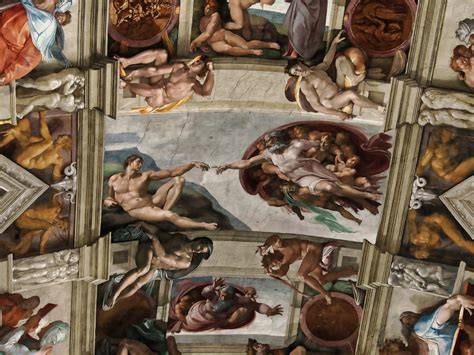
Analysis of the Creation of Adam by Michelangelo
| Aspect | Detail |
|---|---|
| Artist | Michelangelo Buonarroti |
| Location | Sistine Chapel ceiling, Vatican Museums, Vatican City |
| Medium | Fresco |
| Dimensions of Adam panel | Approximately 280 by 570 cm |
| Period | 1508-1512 |
| Theme | Creation of Adam from Genesis |