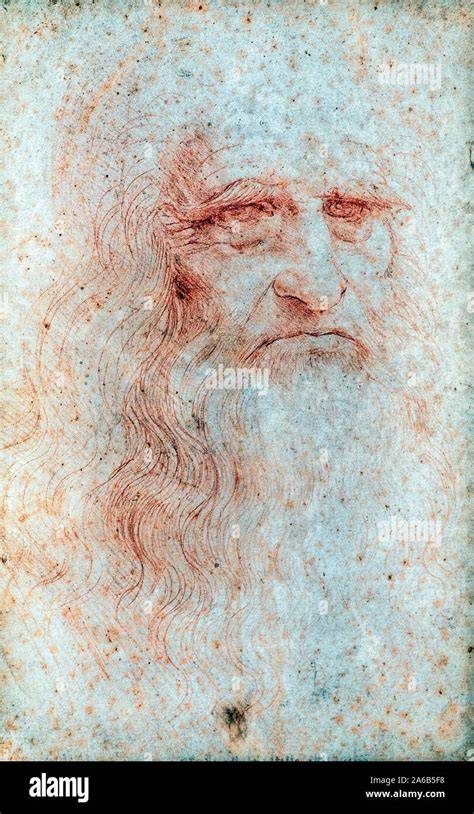
This self portrait was painted in 1512 using red chalk, when Leonardo da Vinci was 50 and living in France. measures 33.3 x 21.3 cm (13 1/8 x 8 3/8 in). It is now held in the magnificent collection of the Biblioteca Reale, Turin. Leonardo da Vinci's thinking about the power of the artist can also furnish the clue to the famous enigmatic self-portrait in red chalk. is a likeness of himself. Other good reasons apart, however, this portrait perfectly fits the role in which Leonardo had cast himself.
white beard, the severe eyes shaded under bushy brows, was the traditional type for representing philosophers, prophets and also God. painting is related to God. discovering the laws of the universe knows how to manipulate them. This essay reconsiders the mystery of Leonardo's self-portraits by re-examining older theories on the topic in relation to the faces and inscriptions in his Uffizi drawing no. Leonardo da Vinci's famous red chalk sketch of an old man in Turin (fig. 1) was long identified as a self-portrait, corresponding to Raphael's contemporaneous image in his School of Athens of Leonardo in the guise of Plato (Clark 255, Gombrich 71, Pedretti 1990, 81).
This traditional identification of Leonardo's drawing has recently been disputed because of its slightly exaggerated features (Kemp 44). Kenneth Clark already identified two facial types that appear repeatedly in Leonardo's drawings-as well as his "doodles" at the margins of his written manuscripts-as "the two hieroglyphs of Leonardo's unconscious mind": an older man with a "formidable frown, nut-cracker nose and chin, who appears sometimes in the form of caricature, but more often as an ideal" (fig. 2), whose "features seem to have typified for Leonardo vigor and resolution," and an "epicene [i.e. androgynous] youth" (fig. 3) (Clark 121).
Several authors saw examples of the former type as self-portraits of Leonardo, including the (usually hairless) heads of his numerous anatomical studies as well as his "Vitruvian man." Gombrich agreed, with the caveat that Leonardo exaggerated the features in a grotesque manner, to varying degrees (fig. 2). He also identified the second type cited by Clark, the feminine youth, as a self-portrait, at least in Leonardo's earliest drawings (fig. 3).
The young Leonardo was reported to be extraordinarily handsome, yet he acknowledged the danger implicit in the proverbial notion that "every painter depicts himself," which could result in repetition and monotony. Gombrich proposed that the first "nut-cracker" type with its grotesque exaggerations ("the traditional Roman profile") involve humorous, self-deprecating attempts to counter the narcissistic and repetitive tendency evident in the second type of the beautiful (Greek) youth. He placed the Turin drawing (fig. Potential confirmation of Gombrich's account lies in an example that both he and Clark cited, Uffizi drawing 446E, without addressing this specifically as a self-portrait (fig. 4). The drawing juxtaposes two heads, framed above and below by inscriptions in calligraphic notarial script.
Leonardo later added mechanical devices on the verso and to the right on the recto, one large gear overlapping the back of the right head. The meanings of the heads and the inscriptions have never been fully explained. The complex face of the older man on the left is highly detailed. He stares straight ahead with a noble yet grim and weathered visage, and what Kenneth Clark called a "nutcracker" face with over-hanging nose and upward-thrusting jaw (fig. 4a). He appears to be dressed, with the top of some clothing visible around his neck (fig. 4).
Carlo Pedretti transcribed the top inscription as "Fieravantj di Domenicho in Firenze e chompar/ amantissimo quanto mio…" but was unable to read the last word(s) (fig. 1a). "In dei nom[ine]" is written below, the repetition "amant[issimo] quanto" just above the left head, and partly torn away at the bottom of the sheet "d[icem]bre 1478 jnchominciai le 2 Vergini Marie […] e chompa in Pisstoja" (Pedretti 2003, 55). Leonard Barkan remarked that in Leonardo's drawings "image and text have been conceived as purposefully interrelated" (Barkan 14). Rosand observed that in 446E "the two facing heads, so poignantly juxtaposed, seem either commentary on or illustration of the written confession-although they likely preceded the writing" and proposed that "the ellipsis may be indicative of the emotion, or even anxiety(?), with which it was penned" (Rosand 64).
Leonardo used the notarial chancery script seen here solely for noting important events. Several pieces of evidence indicate Leonardo's homoerotic preference; most notably, he was publically accused of sodomy in 1472. The seemingly self-evident interpretation put forward here has likely not been proposed before because the figure on the left appears to be too old for the then twenty-six year old Leonardo. However, Gombrich's account of Leonardo's caricature self-portraits resolves the matter, particularly when we juxtapose the face's distinctive features with comparable examples. These include another of his drawings in the Uffizi, no 449E, which has not been recognized as a caricature self-portrait, and bears the second type of androgynous youth on the verso (figs. 2a, 4a, 5, 5a, 5b).
Gombrich's account also helps to account for the feminine-looking youth on the right as Fieravanti, who assumes Leonardo's former role (figs. The two heads relate to one another in terms of the conventional dichotomy of active, masculine, older lover and passive, feminine, younger beloved, or eromenos and erastes. The conventional dichotomy is slightly complicated in this case insofar as the younger man appears outwardly to express the greater love, or at least a greater fascination, through his contorted pose and intense gaze. The twenty-six year old Leonardo would thus have humorously and self-deprecatingly caricatured himself as the "older man" in his relationship to Fieravanti, and in Clark's words, as the more vigorous and resolute of the two companions. The rigid expression of the left head does not betray the depth of his feeling.
Conversely, what Rosand called Leonardo's "written confession" in the top inscription appears to convey his intense emotion, or even anxiety, perhaps at the two lovers' inevitable parting, or the dangers implicit in such a liason. The lapidary repetition of the phrase "amant[issimo] quanto" just above the left head even suggests a visualization of Leonardo's profound feelings for Fieravanti, like thought or speech bubbles in comic strips. Fig. 1 Leonardo da Vinci, Bearded old man (self-portrait?), Turin, Biblioteca Reale, 33.3 x 21.4 cm, inv. no. 15571. Fig. 2 Leonardo da Vinci, "Darius" (warrior in profile with armor), 28.5 x 20.7 cm., inv. no. 1895-9-15-474, London, British Museum. 2a. detail: face. Fig. 3 Leonardo da Vinci, Studies of Madonna and child and faces, c. Fig. 4 Leonardo da Vinci, Two heads with inscriptions in notarial script, studies of mechanical devices, 20.2 x 26.6 cm, inv. no. 446E, Gabinetto Disegni e Stampi degli Uffizi, Florence. Verso: Mechanical devices. 4a. detail: face. Fig. 5a Leonardo da Vinci, Young man in the antique manner, inv. no. 449E, 10.5 x 7.8 cm, Gabinetto Disegni e Stampi degli Uffizi, Florence. Verso: youth. 4a. detail: face. Details 5c. detail, face; 2a. detail, face (reversed); 4a. David Rosand, Drawing Acts.
This year’s opportunity to encounter the works of the Maestro preserved in the collections of the Royal Library of Turin offers a totally new approach, dedicated to the famous Self-portrait of Leonardo da Vinci, the history of art’s greatest icon of all time: a unique opportunity to look the great artist in the eyes. Benefitting from the High Patronage of the President of the Republic and with the patronage of the Piedmont Region, the exhibition Leonardo’s Self-Portrait. History and contemporaneity of a masterpiece, curated by Paola Salvi, is a time machine which, thanks to a number of prestigious loans, will allow you to discover drawings and projects created by Leonardo during the last phase of his life - from his plans for changing the course of the Loire to his geometric studies, to his reflections on painting in relation to the spectator regardless of time, and includes a selection of works from the Royal Library of Turin, including the Codex on the Flight of Birds, anatomical studies of the human body and those of the horse.
The exhibition is augmented by a large selection of paintings, drawings, engravings, intaglio matrices and photolithographs which document the fortune of the famous drawing of Turin and the face of the Genius from the sixteenth to the nineteenth century. The exhibition Leonardo’s Self-Portrait. The main Salon also features a video that recounts the voyage of Leonardo’s Self-Portrait and of the Codex on the Flight of Birds on a microchip carried by the Rover Curiosity, launched from Cape Canaveral on November 26, 2011. For the entire duration of the exhibition, the façade of Palazzo Reale will host a videomapping sponsored by the Consulta per la Valorizzazione dei Beni Artistici e Culturali di Torino and by the Unione Industriali Torino.
The exhibition Leonardo’s Self-Portrait. History and contemporaneity of a masterpiece is arranged in the two vaults of the Biblioteca Reale, created in 1998 and 2014 with the support of the Consulta per la Valorizzazione dei Beni Artistici e Culturali of Turin. In the first exhibition room, and displayed for the first time next to Leonardo’s Self-Portrait, is a precious manuscript from the Biblioteca Nazionale of Naples containing the Diary of the Itinerary of Cardinal Luigi of Aragon written by Antonio de Beatis, who accompanied the Cardinal in his journey through northern Italy, Germany, France and the Netherlands and who with him visited Leonardo in the Castle of Clos Lucé on 10 October 1517; from this chronicle we obtain a precious first-hand testimony of Leonardo’s appearance at that date, of the studies he was conducting, of the paintings most dear to him still in his atelier, of the enormous amount of papers on artistic and scientific subjects that had occupied him all his life, on which the artist, showing signs of age but still extremely active, continued to work.
The contextualization with the French period is made possible by the exceptional loan of six sheets of the Codex Atlanticus from the Veneranda Pinacoteca e Biblioteca Ambrosiana in Milan, drawn between 1517 and 1518: This is a group of drawings, exhibited together for the first time together with the Self-Portrait, from which we obtain invaluable proof of his continued ability to draw and write in a firm and precise way, of the projects and research that the artist continued to incessantly pursue during the final stages of his life and of the constant relationship of exchange and intimate sharing with Francesco Melzi, the pupil who would inherit his immense legacy of drawings that the artist-scientist would have liked to have become books on the subjects that had occupied him during his lifetime.
Among the folios on display are 770v of the Codex Atlanticus, in which, together with a number of sketches in Leonardo’s hand, there is a study by a pupil which depicts a left hand ‒ believed to be Leonardo’s ‒ sketching the waviness of the hair with a technique similar to that of the Self-Portrait; folio 920r which contains studies for the creation of canal works of the Loire and the memory of the visit to Romorentin, in the company of the King of France; 309v in which Leonardo annotates a fundamental reflection on the principles of representing a face: “That face which in painting sees the face of the maestro who makes it, always sees everyone who looks at it”. In the case of a self-portrait, the face looking at the maestro who makes it is of the artist himself: Leonardo reminds us that the maestro wanted to leave an image of himself not only to be looked at, but which continues to look at us.
Folio 307v is also on display, one of the most spectacular in the Codex Atlanticus, with studies on the squaring of curvilinear elements and on geometric equivalence, topics that were almost an obsession with Leonardo from the Roman years until the end of his life. And again 673r, a double folio with the last date noted by Leonardo: “24 June, the day of St. To best illustrate the working method of Leonardo, having brought his manuscripts to France, and the drawings that he used and revived for new projects, other important sheets from the collection of the Biblioteca Reale are on display. We find the Codex on the Flight of Birds, not only with the studies that give the volume its title, but also with an engineering sketch for the creation of canals on the Arno and, on sheet 10v, a small face sketched in red stone, in which Carlo Pedretti in 1975 noticed the similarity with the Self-Portrait.
Furthermore, while the Studies of Insects testifies to his inexhaustible and continuous interest in the natural world, the study of proportions of the face and eye is part of a series of folios dedicated to the proportional theories that would be taken up again in the twentieth century to find the appropriate measures for a three-dimensional translation of the Self-Portrait. Studies on horses continued to have importance and relevance, both in relation to the anatomy of what Leonardo himself considered the most noble of animals, and in relation to the projects for (unrealized) equestrian statues for Francesco Sforza and Gian Giacomo Trivulzio: these are the Studies of a horse’s front legs on olive green prepared paper, the Studies of a horse’s front legs on indigo prepared paper and the Studies of a horse’s hind legs in red stone.
In the second room, the exhibition continues with works that attest to Leonardo’s success starting from the second half of the sixteenth Century: testifying to the knowledge of the Self-Portrait before its purchase by King Carlo Alberto di Savoia Carignano in 1839, two folios preserved in Gabinetto dei Disegni e Stampe delle Gallerie dell’Accademia of Venice, part of the collection of Giuseppe Bossi, multifaceted neoclassical artist and secretary of the Accademia di Brera Study for Heraclitus, attributed to Giovan Ambrogio Figino (circa 1570), and the copy of the Self-Portrait created by Raffaele Albertolli (circa 1808-1809), as attested by Bossi himself. The section dedicated to the success of the Self-Portrait continues with drawings, paintings, prints, books and a marble herm of Leonardo by Pompeo Marchesi (1808), on loan from the Accademia di Belle Arti di Brera. Of notable interest is the drawing of Leonardo’s face by Giuseppe Bossi himself for his Life of Leonardo da Vinci (1812), the model for the print by Pietro Anderloni, with which the iconography of the Renaissance maestro was consolidated.
The exhibition is completed with the analysis of the dissemination of Leonardo’s Self-Portrait in the era of technical reproducibility, through the figures of Carlo Felice Biscarra, secretary of the Accademia Albertina of Turin who, in 1870, etched the Self-Portrait which was subsequently published in the magazine L’Arte in Italia, and of the photographer Angelo della Croce, who travelled to Turin to photograph the Self-Portrait and reproduce it in photolithography for the famous Saggio delle opere di Leonardo da Vinci, published on the occasion of the Leonardesque Celebrations of 1872 in Milan, the year in which the monument dedicated to the artist was also erected in Piazza della Scala.
The itinerary in the second exhibition room also includes a painting by Giovanni Antonio Bazzi, known as Sodoma, a very intense Ecce homo from a private collection which can be admired again, some eight years after the last public exhibition. The exhibition occasion is enriched, for the first time, with a pictorial section curated by Annamaria Bava within the Galleria Sabauda: Beholding Leonardo. Furthermore, in the context of the depiction of the face, from the first floor of the Galleria Sabauda to the Giardino Ducale, a selected exhibition of sculptures by Giuliano Vangi (Barberino di Mugello, Florence, 1931 - Pesaro 2024) is proposed, fifteen works marked by a peculiar expressive intensity, always within the solemnity of their bearing.
Effected between 1964 and 2022 in a range of widely different materials ‒ marble, wood, bronze, stone, glass ‒ with which the sculptor loves to experiment, they let us retrace the path of an internationally known and celebrated artist, who has taken up the testimony of the great Italian sculpture over the centuries. The exhibition, Giuliano Vangi. Leonardo’s Self-Portrait. The rich collection of graphics in the Biblioteca Reale contains over 2,500 drawings, including an important nucleus of 1,585 sheets by old Italian and European masters, sold in 1839 to King Carlo Alberto by Giovanni Volpato from Chieri, a particularly interesting character who, after emigrating from Italy, built a brilliant career abroad as an art dealer, working between France and England, before returning to Piedmont in 1837, bringing with him a very rich collection.
Precisely in those years, King Carlo Alberto was engaged in the creation of his own collection, conceived and desired as a collection of wonders, in the wake of a family tradition: an instrument of personal prestige and celebration of the Savoy dynasty, for the creation of which he had commissioned the Bolognese architect Pelagio Palagi and a large group of intellectuals led by Domenico Promis. At the heart of this fortunate purchase, in which there are also sheets by Michelangelo, Rembrandt, Carracci, Guercino, Canova and many others, is the nucleus of thirteen autograph drawings by Leonardo da Vinci which document his activity and interests of the Renaissance Genius from his youth to full maturity.
Some refer to famous masterpieces of the maestro, such as the nudes for the Battle of Anghiari, the horses for the Sforza and Trivulzio monuments, the study for the angel of the Virgin of the Rocks, known as the Face of a Maiden; others, such as the Proportions of the face and the eye, testify to his research on anatomy and the “motions of the soul”, of which Leonardo was the undisputed master. Up to the unicum, the Self-Portrait, one of the most famous icons in the history of art. Portrait of a Man in Red Chalk (c. 1510) is a drawing currently in the collection of the Royal Library of Turin. It is widely, though not universally, accepted as a self-portrait of the Renaissance artist Leonardo da Vinci. It is thought that Leonardo drew this self-portrait at about the age of 60. The portrait has been extensively reproduced and has become an iconic representation of him as a polymath or "Renaissance man".
The portrait is drawn in red chalk on paper. It depicts the head of an elderly man in three-quarter view, his face turned towards the viewer. The subject is distinguished by his long hair and long, waving beard, which flow over the shoulders and chest. The length of the hair and beard is uncommon in Renaissance portraits and suggests, as now, a person of sagacity. The face has a somewhat aquiline nose and is marked by deep lines on the brow and pouches below the eyes. It appears as if the man has lost his upper front teeth, causing deepening of the grooves from the nostrils. The eyes of the figure do not engage the viewer but gaze ahead, veiled by the long eyebrows. The drawing has been drawn in fine, unique lines, shadowed by hatching and executed with the left hand, as was Leonardo's habit. In 1839, Giovanni Volpato, an antiques dealer who may have purchased the drawing in England or France, sold it to Prince Charles Albert of Sardinia with other drawings of great artists such as Raphael and Michelangelo.
Researchers have developed a nondestructive way to gauge the condition of the drawing by describing and quantifying the chromophores affecting the paper. The drawing is estimated to have been drawn c. 1510, possibly as a self-portrait by Leonardo da Vinci. In 1839, it was acquired by King Carlo Alberto of Savoy. The assumption that the drawing is a self-portrait of Leonardo was made in the 19th century, based on the similarity of the sitter to the possible portrait of Leonardo as Plato in Raphael's The School of Athens and on the high quality of the drawing, consistent with others by Leonardo. It was also decreed to be a self-portrait based on its likeness to the frontispiece portrait of Leonardo in Vasari's second edition of The Lives of the Artists (1568). Since the mid-to-late 20th century, the identification of the drawing as a self-portrait has been questioned.
The claim that it represents Leonardo has been criticized by a number of Leonardo scholars and experts, such as Robert Payne, Martin Kemp, Pietro Marani, Carlo Pedretti, Larry J. Other portraits of Leonardo by himself and other hands exist, presenting a different image of Leonardo than the man represented in the red chalk drawing. Another red chalk drawing, a profile portrait at Windsor, is attributed to his pupil Francesco Melzi. There is no scholarly consensus on the attribution of the Lucan portrait to Leonardo, but it has at least on occasion been attributed to him. The engraving portrait by Raffaello Morghen and statue by Luigi Pampaloni were made after his lifetime.
Leonardo da Vinci Self-portrait Could Grant Magical Powers, Hidden From Hitler
Thus the Turin self-portrait has generated debate about authorship, self-representation, and the artist’s self-conception. The material surrounding the drawing, its inscriptions, and its relationship to Leonardo's other portraits and studies continues to fuel discussion about what it means for Leonardo to look back at us through a chalk line and gaze. The image, whether read as self-portrait or as a symbolic representation of Leonardo’s role as philosopher and master, remains a focal point in the discourse on Leonardo as the quintessential Renaissance mind.
Key themes and debates
- The two recurring facial types in Leonardo’s drawings: the aged, “nut-cracker” form and the androgynous youth.
- The interplay of image and inscription in Leonardo’s drawings as potential “written confession.”
- Questions of authorship, self-portrait conventions, and the evolution of self-representation in Leonardo’s late works.
- The Turin Self-Portrait in the broader context of Leonardo’s final projects, codices, and exchange with Melzi.
- The iconographic significance of the beard, gaze, and physiognomy in signaling Leonardo’s self-perception as thinker, painter, and innovator.
Related works and comparative instances
- Uffizi drawing 446E: two heads with inscriptions, linked to discussions of self-portraiture and the left-hand habit in Leonardo’s drawing.
- Uffizi 449E: potential caricature self-portrait and the verso with another youthful figure.
- Codex Atlanticus folios (770v, 920r, 307v, 673r): studies illustrating Leonardo’s ongoing engagement with face proportions, geometry, and the interaction of image and text.
Significance for the study of Leonardo
The Turin drawing sits at the crossroads of art history, anatomy, and the philosophy of art. It invites us to consider how Leonardo envisioned the artist’s power to observe, to reveal, and to manipulate the laws of nature through drawing and invention. The inscriptions and the juxtaposition with other heads add layers to interpretations about desire, mentorship, and the social networks that surrounded Leonardo in his later years. Through the lens of this single image, scholars continue to probe the wider question: how did Leonardo imagine the act of looking at the world and at himself?