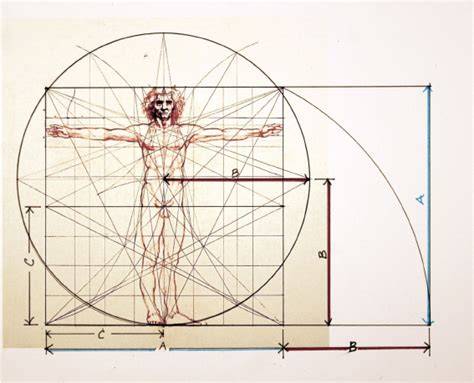
The Vitruvian Man was created by Leonardo da Vinci around the year 1487. It is accompanied by notes based on the work of the famed architect, Vitruvius Pollio. The paper depicts a male figure in two superimposed positions with his arms and legs apart and simultaneously inscribed in a circle and square. The proportional relationship of the parts reflects the universal design and a “medical” equilibrium of elements ensures a stable structure, tying the body to concepts of architecture and nature. In the late 1480s, this theme of the artistic microcosm emerged as one of the great unifying principles of his thought. This image provides a perfect example of Leonardo's keen interest in proportion and relates man to nature as a cosmography of the microcosm.
Origins and influences
The title Vitruvian Man refers to the Roman architect Vitruvius, who lived from around 80-70 BC until about 15 BC. Vitruvius drew on geometric symbolism to develop a theory of cosmic order and its application to building projects. His The Ten Books on Architecture described the virtues of a well-considered building and explored civic projects like town planning and waterworks. The idea that the circle represents the divine and the square the earthly shaped later Renaissance thinking about harmony and proportion.
Leonardo was not the first to engage Vitruvius’s proportions. An earlier drawing by Giacomo Andrea Da Ferrara, centering the circle on the navel, likely influenced Leonardo. Leonardo’s own studies expanded from Vitruvius’s measurements, allowing him to adjust the relationship of circle and square and to place the outspread arms and legs touching the circle’s edge while the navel remains the center. In this way, Leonardo moved beyond classical templates with his empirical approach.
The drawing and its accompanying notes
Two blocks of text accompany Leonardo’s drawing. They record the ideal body measurements according to Vitruvius, such as: four fingers equal one palm; four palms equal one foot; six palms equal one cubit; four cubits equal one man; and twenty-four palms equal one man. The notes also state that the length of the outspread arms equals a person’s height, and give various ratios from the hairline to the chin, from the chin to the top of the head, and from chest to head. Leonardo’s notes reveal his intention to translate Vitruvian principles into a practical representation of the ideal human body, blending observation with proportion.
Leonardo offset the square from the circle and depicted the man in two positions: one with arms and legs outstretched to touch the circle and square, centered at the navel; and another with legs together and arms spread so the hands touch the sides of the square. His empirical measurements allowed him to refine Vitruvius’s principles and to propose a more dynamic and accurate model of human proportion.
Meaning and significance
The Vitruvian Man embodies a fusion of humanism, geometry, anatomy, and art. The circle and square symbolize cosmic and earthly order, and the arrangement of the figure within them reflects the Renaissance belief that the human body is a microcosm of the universe. Through geometry and anatomy, Leonardo elevated the status of fine arts, aligning artistic practice with scientific inquiry. The drawing thus stands as a paradigm of High Renaissance thinking, uniting art, science, and philosophy in pursuit of universal laws governing nature and humanity.
Although often celebrated as a broad symbol of ideal human proportions, the drawing also bears the marks of its historical context. Leonardo conducted his research during his early Milanese period, drawing on Vitruvius while incorporating his own observations. Some scholars have debated the possible influence of the golden ratio, though consensus suggests the Vitruvian ideal predates Pacioli’s Divina proportione and that the drawing likely reflects Leonardo’s independent inquiry.
Provenance and display
The Vitruvian Man is housed at the Gallerie dell’Accademia in Venice, where it remains one of the gallery’s most cherished works. Due to its fragility, the drawing is rarely displayed, though it has traveled for major exhibitions, such as the 2019 loan to the Louvre in Paris for Leonardo’s death anniversary. The image has become one of the most iconic emblems of Western art, science, and culture, illustrating Leonardo’s lasting impact on how we conceive the relationship between the human body and the order of the cosmos.
Leonardo’s Vitruvian Man continues to inspire modern discussions about anatomy, architecture, and the philosophy of proportion. It stands as a quintessential example of how Renaissance thinkers bridged disciplines to articulate a unified view of knowledge, and it remains a touchstone for debates about the intersection of art and science in the portrayal of the human figure.
Why is the Vitruvian Man by Leonardo da Vinci so important?
In sum, the Vitruvian Man represents the archetypal Renaissance man: a figure who embodies the harmony of mind and body, art and mathematics, and the microcosm of human nature within the macrocosm of the universe. Its enduring appeal lies in its elegant synthesis of empirical observation with a philosophical vision of order and proportion.