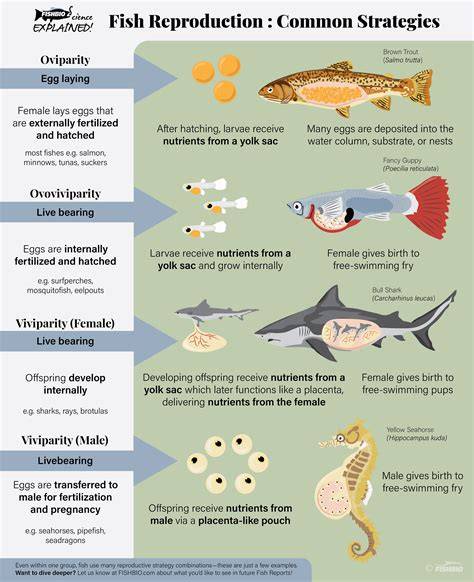
The embryological development of the rice-paddy fish, from fertilization to hatching, is followed in the laboratory. The embryological development of the rice-paddy fish, from fertilization to hatching, is followed in the laboratory. The methods of reproduction in fishes are varied, but most fishes lay a large number of small eggs, fertilized and scattered outside of the body. The eggs of pelagic fishes usually remain suspended in the open water. Many shore and freshwater fishes lay eggs on the bottom or among plants. Some have adhesive eggs. In bony fishes a sperm duct leads from each testis to a urogenital opening behind the vent or anus. In sharks and rays and in cyclostomes the duct leads to a cloaca. Sometimes the pelvic fins are modified to help transmit the milt to the eggs at the female’s vent or on the substrate where the female has placed them. Sometimes accessory organs are used to fertilize females internally-for example, the claspers of many sharks and rays. In the females the eggs are formed in two ovaries (sometimes only one) and pass through the ovaries to the urogenital opening and to the outside. In some fishes the eggs are fertilized internally but are shed before development takes place. Members of about a dozen families each of bony fishes (teleosts) and sharks bear live young. Many skates and rays also bear live young. In some bony fishes the eggs simply develop within the female, the young emerging when the eggs hatch (ovoviviparous). Others develop within the ovary and are nourished by ovarian tissues after hatching (viviparous). There are also other methods utilized by fishes to nourish young within the female.
In all live-bearers the young are born at a relatively large size and are few in number. In one family of primarily marine fishes, the surfperches from the Pacific coast of North America, Japan, and Korea, the males of at least one species are born sexually mature, although they are not fully grown. Some fishes are hermaphroditic-an individual producing both sperm and eggs, usually at different stages of its life. Self-fertilization, however, is probably rare. Successful reproduction and, in many cases, defense of the eggs and the young are assured by rather stereotypical but often elaborate courtship and parental behaviour, either by the male or the female or both. Some fishes prepare nests by hollowing out depressions in the sand bottom (cichlids, for example), build nests with plant materials and sticky threads excreted by the kidneys (sticklebacks), or blow a cluster of mucus-covered bubbles at the water surface (gouramis). The eggs are laid in these structures. Some varieties of cichlids and catfishes incubate eggs in their mouths. Some fishes, such as salmon, undergo long migrations from the ocean and up large rivers to spawn in the gravel beds where they themselves hatched (anadromous fishes). Some, such as the freshwater eels (family Anguillidae), live and grow to maturity in fresh water and migrate to the sea to spawn (catadromous fishes). Other fishes undertake shorter migrations from lakes into streams, within the ocean, or enter spawning habitats that they do not ordinarily occupy in other ways.
Form and Function: Body Plan and Reproduction
The basic structure and function of the fish body are similar to those of all other vertebrates. The usual four types of tissues are present: surface or epithelial, connective (bone, cartilage, and fibrous tissues, as well as their derivative, blood), nerve, and muscle tissues. In addition, the fish’s organs and organ systems parallel those of other vertebrates. The scales, swim bladder, and gills play crucial roles in respiration and buoyancy. The typical fish body is streamlined and spindle-shaped, with an anterior head, a gill apparatus, and a heart lying in the midline just below the gill chamber. The body cavity houses vital organs and is situated behind the head in the lower anterior part of the body. The anus usually marks the posterior termination of the body cavity and most often occurs just in front of the base of the anal fin. The spinal cord and vertebral column continue from the head to the base of the tail fin, passing dorsal to the body cavity. Most of the body is muscular, which is necessary for swimming. Evolution has produced numerous forms of fish shapes, yet the basic plan persists as an integral part of locomotion and protection of vital parts.
The internal skeleton consists of skull bones, the vertebral column, and fin supports. The fin supports are derived from the external skeleton and relate closely to the internal skeleton. The internal skeleton of cyclostomes, sharks, and rays is cartilage; bony fishes have vertebrae that may partially replace the notochord. The skull of bony fishes is at least partially ossified, while sharks and rays retain a cartilaginous skull. The supportive elements of the fins have changed greatly during evolution.
Most fishes possess a single dorsal fin on the midline of the back, with many having two or three dorsal fins. The other fins include the single tail and anal fins and paired pelvic and pectoral fins. Some primitive teleosts carry an adipose fin near the caudal base. Aquaculture research, including at IMET, aims to improve breeding and produce offspring reliably. Aquaculture can help reduce reliance on wild fish as a food source. Understanding the endocrine system and the brain-pituitary-gonad axis is essential to encourage reproduction in captive stocks. The Zohar Lab at IMET studies these relationships to help farmed fish reproduce successfully.
Fish reproduction encompasses a wide array of strategies. There are explanations of fitness in reproductive terms, the balance of age at maturity, fecundity, and spawning frequency. Semelparous species spawn once in a lifetime; many others spawn multiple times. Trade-offs exist between egg size and fecundity, with smaller eggs permitting more offspring but higher larval mortality. Some elasmobranch taxa skip larval stages, while viviparous sharks nourish embryos via placental connections. Group spawning can increase fertilization success, particularly in large aggregations. Internal fertilization occurs in cartilaginous fishes such as sharks and rays, using claspers in copulation, whereas most bony fishes fertilize externally in the water column. Internal self-fertilization is rare, and many fish exhibit hermaphroditism, either sequential or simultaneous, offering adaptive advantages under different ecological conditions.
In offspring care, many species practice nesting or mouth brooding to protect eggs and fry. For example, nest-building behaviors are observed in cichlids and sticklebacks, while gouramis release bubbles coated with mucus as nests. Mouthbrooding is another strategy found in several species, including certain cichlids and cardinalfish. Some species like salmon migrate long distances to spawn in natal gravel beds, whereas others such as freshwater eels migrate to the sea to spawn. These life-history strategies illustrate the diversity of reproductive adaptation in fishes.
Reproductive Modes and Lab Observations
In the lab, breeding success depends on nutrition and environmental conditions, with daylight, temperature, pH, substrate, and stocking levels all influencing outcomes. Livebearers release live young after internal fertilization, producing fewer but larger offspring, while many egg-layers produce large numbers of eggs laid or deposited in nests or the substrate. The fry require separation from adults to prevent predation, and nursery setups or mesh enclosures help protect vulnerable young. In external fertilization, eggs are laid and fertilized in the water, and many species provide little parental care beyond the initial guarding behaviors.
In captivity, egg-scattering species deposit sticky eggs on substrates or among cover, while depositors may choose a general bottom area for staking a clutch. Mouthbrooders and nest-builders represent two different parental care traditions that help improve hatch rates and larval survival. The beginner aquarist should research species-specific needs and ensure suitable conditions for successful reproduction, including appropriate feeding regimens for fry using finely crushed flakes or live foods. Nurseries may be constructed to house fry and protect them as they grow.
Spawning, fertilization, and early development steps are often synchronized in large populations in the wild and in captivity. In broadcasting spawners, clouds of eggs and sperm mingle in the water, with fertilization occurring externally and little parental care provided. In mouthbrooding and internal fertilization, parental care can be more extensive, offering protection during vulnerable early life stages. Larval stages emerge from eggs as free-swimming larvae with yolk sacs, then metamorphose over time into juvenile and adult forms.
Key Concepts in Fish Reproduction
- External versus internal fertilization; oviparous, ovoviviparous, and viviparous modes.
- Hermaphroditism and sequential sex change (protogyny and protandry).
- Spawning strategies: group spawning, monogamy, and broadcast spawning.
- Nesting, mouthbrooding, and internal nourishment strategies during development.
- Migration patterns tied to spawning, including anadromy and catadromy.
- Laboratory reproduction practice: nutrition, lighting, water chemistry, and specialized housing for fry.
Examples and Notable Behaviors
The most dramatic examples include deep-sea anglerfish males that become parasitic on females, and intrauterine cannibalism seen in sand tiger sharks. Parthenogenesis has been observed in some captive sharks, illustrating diverse reproductive modes beyond simple egg laying. In many species, sexual dimorphism and courtship display influence mate choice and reproductive success. Grouper and snapper spawning aggregations provide insight into how large groups can enhance fertilization efficiency, influencing fisheries management and conservation.